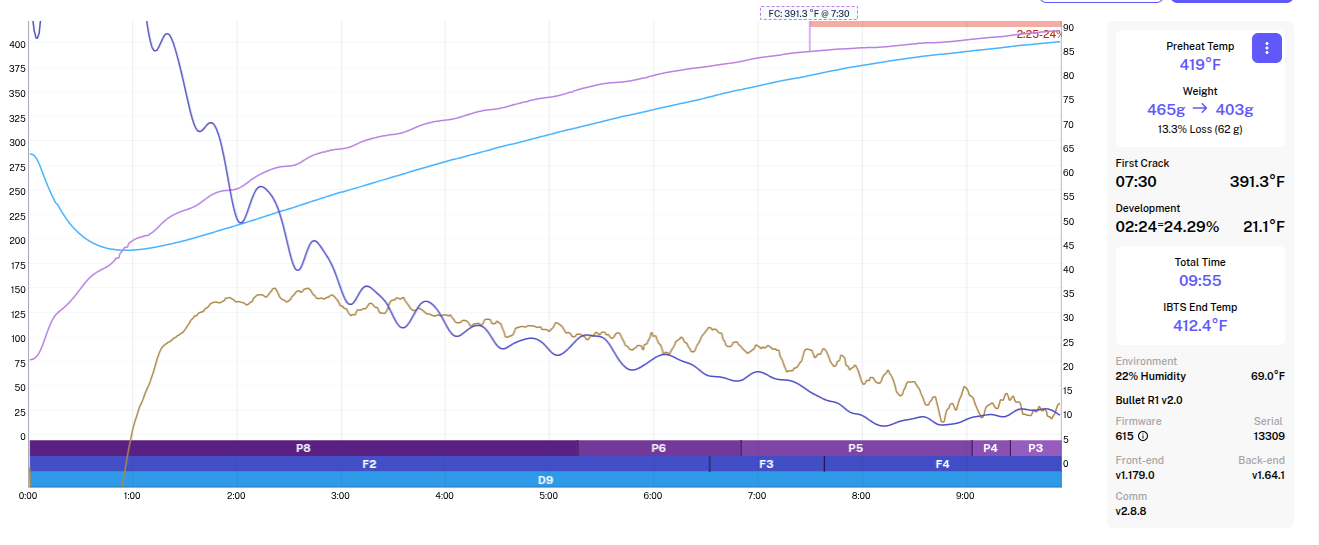
I seem to be having a hard time getting more of a medium roast. A local roaster suggested that maybe I am getting to first crack to fast. Does that suggest I should be utilizing a lower charge temp or starting with a lower heat setting? Roasting 465 gram batches. Bean is from Brazil
I aim for about 15% loss when shooting for a medium. However I also see that your development time was 2:24, which is obviously rather long.
Based on these observations, I believe your preheat is too low and your drum temp is too high. (see recipe suggestion in postscript)
During the beginning of your roast your beans are “storing” heat which will be expelled later and will result in more energy (heat) being released during development (after 1C).
I explain more here:
Hope that helps and isn’t too much.
David
P.S.
specific recipe suggestion for moving forward
Preheat to roughly 270C=518F
Begin at P7 until I-ROR dips to about 20 (about 1.5-2 minutes), then go to P8.
Initiate F3 around the time yellowing begins.
When 1C begins, leave the settings until about 30-45 sec into dev time, at which point go to P7 and F4
You really only have to worry about scorching after 1C begins, or whenever the mallard reaction begins. I’m not making a global claim about roasting–just on the Bullet. I’m pretty sure that green coffee can handle almost any level of heat the Bullet can dish out, that is, from the beginning of the roast to somewhere shortly after yellowing begins.
I have found that it all depends on the set-up, that is, how much and how long I have applied heat from the beginning of the roast to a little after yellowing, 1.5-2 minutes before 1C. I have found that having the heat at or above 8 after roughly a minute into first crack causes scorching.
The drum isn’t too hot, the drum temp (P) is too high; it has to do with heat transfer. Cooking analogies help me: Heat transfer is the property that makes a cast iron pan stay relatively hot longer after it has been removed from heat, compared to say an aluminum pan. The drum being hot(via a higher pre-heat) is akin to letting your pan get hot first, while having a relatively cool drum is like blasting the heat on a cool pan and then immediately putting your steak on it. By the time the inside of the steak in the second scenario is cooked, the outside is burnt, or, scorched, if you like.
What you are trying to do during set-up is provide enough heat for the beans to “store” up while they are endothermic so they can have enough energy (heat) to release which adds to the indirect heat rather than the direct heat. I have seen posts which refer to bean “soak,” you might want to see if you can find some of those which also help in understanding this.
Another note: the infrared sensor is mostly reading the surface of the bean while the probe can get you a better reading of the temperature of the bean mass, which includes the air between the beans and is more greatly affected by the temperature of the entire bean, not just the surface. This is why at first the IBTS temp is much higher than the bean temp. The beans are cool and then you immediately start applying heat to their surface. I could go on… but I think you are getting it.