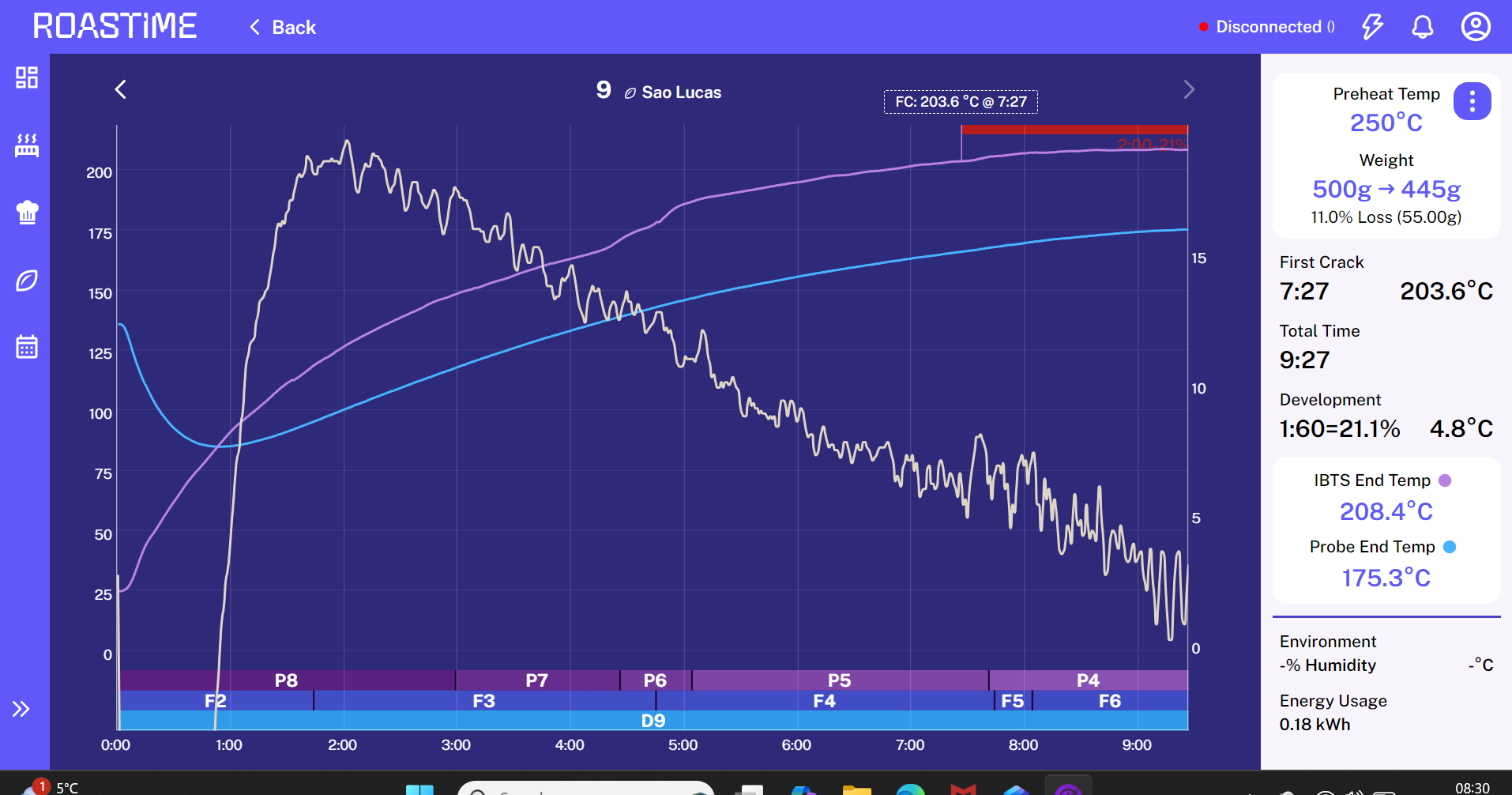
very new to roasting. I’m just wondering if anyone can shed any light on my last roast, in terms of temperature’s and RoR i think it should have been one of my best yet but when its cooled it seems under done. still smelling grassy with a little grassy taste, beans also still seem small and hard not like the other roasts I’ve done where they have increased in size.
so my question is, is it a case of leaving everything the same but just incresing the development time or is it a case of trying to get more early heat into the beans?
My advice is not to get caught up in temperature slopes and lines. Just because they look pretty doesn’t mean they are right for the bean you are roasting. You already identified some important factors about your roast that are fixable using your nose.
“still smelling grassy with a little grassy taste”
What does that tell you? To me, that means the beans are still underdeveloped and could use some more time roasting. So next roast perhaps slow things down. Start the Roast at P7, and F2 or F3 (this is normally where I am at for a 500g roast, F3 for less dense beans). For beans that still taste green, I usually try to extend my Maillard/browning phase on the next roast. For me, development time and temps affect acidity/fruitiness vs. roasty “brown” flavors. Your total roast time was 9:27, so perhaps aim for 10:27 next time and see how that changes your roast.
If this is a new bean, then it may require different treatment.
To my eye, this looks like a pretty fast roast, a fairly low end temp, and a low level of moisture loss. I would expect the bean to be on the less developed end for sure, but it’s all relative to what you were expecting.
Thanks very much for the advice, that’s a great point regarding the profiles looking pretty, and something to bear in mind for future roasts.
another excellent point about slowing things down, like i say this is all new to me so its definitely trial and error, if i can pick up any knowledge along the way then i will.
ill try to aim for a bit longer in the malliard phase next time and see where i come out at.
Thanks again i appreciate your time.
Thanks for getting back to me, its much appreciated.
yes I’ve roasted this bean before, just over the last week to try and get something pretty good tasting and consistent.
previous profiles were more erratic than this one in terms of ROR - and end temps were much higher, i tried to aim for a lower end temp as people were saying to try and drop it at around 215-220 - i think I’ve just gone early as i was afraid of over doing the beans.
previous roasts have tasted good, i would say every one has got better until this one! as I’ve mentioned its all learning so I’m not to fussed i just want to get better and more consistent and understand the the affect the changes make to the overall roast.
i think from what’s been said ill try again but try and extend the roast for a minute longer and try get a higher end temp.
No problem Tom, It’s a learning experience for sure! I’ve only been roasting for about 5 months now., and learning with each roast. Remember that a majority of your flavor is also directly correlated to the final roast color, and you can reach the same color at different drop temps. Generally speaking, if you are aiming for a specific final roast color you can get that with a higher temp, but shorter development time, or a longer development with a cooler temp. All of this within reason of course. Too hot and and you’ll scorch the outside, to cool and you’ll end up baking all the character out of your beans. The trick with all of that is to be able to taste your product, and then now how to make meaningful adjustments to your next roast, with the data you have.
example roast 907g
here is link to one of my roasts, sometimes easier to show then text it.
This month is my one year using bullet from behmor, two years roasting. what my biggest learn was there is a lot of factors to roasting, and for me I started lowering the variables: meaning 9 months ago I started by keeping the drum at D8, keeping the temp steady, and using the fan to change roasting kinetics. Over many roasts and different beans, I started to be able to create a good recipe for my typical roast volume, and each phase starting temp (yellowing and first crack). I would advise you start marking yellowing and first crack every roast. They are subjective but you are doing the roasting, so they represent your roasting style. The first phase is just as important as the next two. I was also having a lot of sharp green characters when I started using the bullet. I started, depending on the bean, developing the first phase, by making sure the whole bean to the center was developing at the same rate, meaning to much heat to fast roast the outside of the bean sealing in the center with underdeveloped flavors. If you look at my. roast, I preheat to recommended temps, dump, slow the temp down, slow the drum down, keep the fan low and let the bean absorb the heat all the way to the center, for a good 50 seconds. When everyone says your learn more as you roast more is a fact, there is to many variables to have a one recipe fits all. Onogrinds!
Thanks a lot for that, that is a really good way of looking at it and something id probably over looked in terms of the end colour. Simple yet effective! I am starting to pick out different flavours when tasting and sort of being able to link that with things in the roast. Again I think the more roasting I do the more consistent I’m getting in terms of the different stages and marking FC etc, this should give me tighter consistency going forward with development times & drop temps etc.
Thanks a lot for you input its really helpful! I’m sure we will speak again! Good luck with your roasting!
Brilliant advice, that makes a lot of sense with regards to marking things as its me who’s doing the roasts so i should mark them at a similar point in terms of hearing FC etc. ill aim to mark yellowing going forward too just felt like recently ive been concentrating on settings and the next step that much ive not had time to mark it!
thanks for sending over a copy of your roast ill have a good look at that before i do my next roast. its very helpful to see the difference in preheat temps from your larger roast.
I don’t think I have too much to add here. I agree with assessment concerning the speed of the roast. That can lead to underdevelopment.
On thing I will add that helps me is thinking of my roast in terms of 1) set-up, everything from beginning of the roast to the end of yellowing, not long before first crack (1C) will begin. And 2) Development: everything after 1C begins.
When you are aiming for a light(er) roast, it is more important to get the set-up right as your development time will be so low that you run the risk of an underdeveloped coffee. When aiming for medium and above, this doesn’t matter as much as you end up getting more out of the development time itself.
To me, at 500g, your heat is too high up front and thus your set-up was too short. If you find your heat lacking overall, then try upping your preheat temp so that you can lower your Plevel throughout your roast.
Additionally, there are thermodynamic principles at work very similar to cooking. If you want to caress something through the end of its cooking time, you have to go low and slow, whereas if you just want to sear the outside, high and fast will do the trick.
The infrared sensor is mostly sensing the temperature of the surface of the beans. The bean probe is measuring the temperature of the bean mass which includes surface temperatures, but also ambient temperatures which includes the heat coming from the center of your beans. The fact that your bean probe temp and ibts are so disparate tell me that the surface of your beans is probably much hotter than the center of your beans. Thank about a steak or piece of protein again. When you blast it with heat, the outside cooks while the inside remains cool.
There’s also the fact that during the beginning of the roast, more or less corresponding with “set-up” your beans are endothermic, whereas during “development” they become exothermic
Thanks for that input David, I appreciate your time. thats another good way of explaining it in terms of searing the steak, thats allowed me to understand things abit better.
im going to try and repeat the roast with a higher pre heat temprature but then try and slow the roast down during with lower power settings. Hopefully from everyones advice over the last week or so i can get a pretty decent roast going forward!