What's a reasonable Bullet roast curve?

I just got a Bullet R2 and I’m new to roasting on a Bullet (coming from a Behmor), so in prep for this I’ve read a lot about roasting online and from authors like Scott Rao. In learning about roast curves, I understand now that commercial roasters use ET/BT while we only get BT, since Aillio chose not to give use ET data. Even without the traditionally expected data, I would think that we should still see smoothly descending ROR curves from our BT sensor, but I’m not seeing in many roast profiles on Roast.World where the Bullet ROR curve descends particularly well. A lot of them seem to peak, descend, and then level out toward the middle/end. Here’s an example of one I was looking at. I have this same blend and want to roast it on the Bullet, and the numbers for this profile look good but the curve seems flat in my opinion:

I’m trying to learn how to do it properly, but I’m 5 lbs in (after seasoning roasts) and so far my roast deltas are 30-40 AgTron points, so obviously I’m doing something wrong. I also recognize that ROR curves are not one-size-fits-all and there will be variations with different roasters and different beans, but with each roaster there should be a reasonably expected curve that will result in a good roast (excluding edge cases) and I want to understand that about the Bullet.

Main questions:
Is a smoothly descending curve—like those that commercial roasters often present as ideal—something I should expect when roasting on the Bullet, or should I anticipate my ROR curves leveling out toward the end?
Does the Bullet behave similarly to large commercial drum roasters, so that best practices aimed at machines like a Probat can generally be applied to the Bullet?
This isn’t just a function of IBTS vs BT ROR curves, or roaster preferences or habits-- it’s a matter of models that are physically (and mathematically) impossible to execute for certain combinations of roast color/end temp, first crack times, and development times.

There are people who assert that this is not a worthwhile target to pursue. It’s based on anecdotal evidence from a consultant (Rao) who sells his expertise, and a key component of that package is the “smoothly declining ROR.”

The most important thing is cup quality, which is 100% subjective. The factors that contribute to that, based on reproducible evidence, are, in rough order of descending importance:

  1. Green bean quality
  2. Roast degree (color + internal development)
  3. Application of heat over time (heat plan)
  4. Development time (time post first crack)
  5. Time to first crack
  6. Other factors like fan, drum speed, etc.

The problem is, a “smoothly declining ROR” is mathematically impossible for certain combinations of FC time, development time, and end temperatures. You physically (due to physics, and math) cannot construct a smoothly declining derivative of the time temperature curve when, for example, you want to control all three of time to first crack, end temp, and development time for many reasonable constraints.

So, in order to get a smoothly declining ROR, you have to buy in to a set of postulates that constrain how dark you can roast coffee and/or how quickly you can roast it, and roasting it more quickly (all other things being equal) definitely impacts internal development and overall flavor in the cup.

If that works for you, great. Otherwise, experiment , taste, repeat.

More reading, and a free course here: Learning - #4 by gilbertwilliamson.db

That makes complete sense, especially given that it’s ultimately down to physics and math, and there’s no way to make them conform to any ruleset outside of the laws of physics.

Application of heat is my biggest struggle right now. I really don’t know when to apply heat or how much; my last couple of roasts seem to have plateaued right after first crack, which makes me think I started stepping my heat down too early in the roast. I just registered for that course to soak up some more knowledge. Will it discuss heat application?

Yep, for sure. There’s a self-guided experimental portion where you get to learn to control the heat inputs to get the desired outcome.

Once you learn to drive the roaster, you can target different outcomes and decide which ones work for you.

1 Like

Exhaust Temperature in gas/flame roasting is used to predict where the BT curve is headed, because the air temp is hotter than the Bean Probe.

The Aillio Bullet air flow temperature does not seem to be hotter than the drum, since the drum is the heating source and not a flame. so the exhaust temperature is not good for predicting the roast.

Using temperature measuring on the Bullet:

air or exhaust temperature can be used to understanding the convective energy in the roast.

Bean Probe on the Bullet or any machine is measuring the beans external temperature. A: on a gas roaster this is a good indication of the roast. B: on the Bullet it is a little less effective since the convective heat lags behind bean temperature. If the machine were more convective, then a BT implies some aspect of roast level, but with a conductive heat application, BT can be wildly different from internal bean temperatures

The visual heat sensor on the bullet is great too, but I do not fully understand what it measures. how much it filters out noise etc. Despite that, it is the best predictor of how the roast will go.

so why use exhaust temperature on the bullet? it is good for understanding how the beans are being roasted, and if the airflow is consistent with the rest of the roast. The RoR for BT and IR can be rising while the ET RoR is declining. While ET is not the best predictor, it is still an important tool for understanding how the roast is behaving.

On the Bullet, I use IR for prediction, and a combination of BT and ET for completion, or measuring “done-ness”.

ET is also useful for diagnosing roaster issues when the other roast curves aren’t showing the whole picture.

1 Like

If you’d like to see a profile that comes closer to what you are asking about, I have one. It isn’t perfect, but it shows you that not all curves look the same on the Bullet. This is not the coffee you are roasting but it shows a generally declining ROR. So, yes, the Bullet can roast the way you program it to. From a voice of experience, ROR is not a magic bullet. I generally aim for a drying time (roughly 4-6 minutes), a Maillard time (roughly 3-5 minutes), and an ending temperature (depends on light, medium, dark). When I get those three where I want them I usually enjoy the cup.

roast.world/nomad/roasts/yN2Z_Efm2-dD-ZvMptCm-

1 Like

i found the Bullet to just be weird. which this doesn’t seem to be most users experience.

all other roasting methods have felt somewhat similar. pan, whirly pop, oven, hottop, fluid bed, ans gas drum all seem to just work. the Bullet has been a real weird experience.

the steady declining RoR and power levels seems to work for most people here, and I have a theory that a well functioning Bullet should get best results that way, but some outlier Bullets don’t seem to operate the same way and roast curves are a little less smooth, and may have some dips and reversals.

i know for a fact, having swapped a few parts that there are differences in bullet behavior. as i made changes to the machine to bringnit closer to standard operating behavior, I get closer to results that mirror the average user here.

I’m curious about your experience with this… what parts seemed to change the roasting process for you?

A few things:

  • the induction electronics would over heat at P7 or above, because it pulled more wattage. so i couldn’t roast full batches the same way, and my P7 was other peoples P8 etc. swapped to a diferent induction, but haven’t calibrated it to the drum yet. i heard that is now possible. will try it soon.

  • rear fan and chaff compartments were different generations, so they didn’t match up, so there was some subtle airflow leakage and it did not pull air flow through the machine in a normal way. really difficult to get good airflow that wasn’t too low or too powerful.

  • the rear insulation was either not there or had sifted and settled, the gap allowed hot air from the drum directly up to where the plastic chaff box mated with the roaster body. things warped and wore out and that messed up airflow further.

some of the other issues may not have been issues without the things listed above.

measuring the exhaust temps was helpful in trouble shooting though. i could see bigger changes there than with the IBTS when it came to airflow issues.

i’m about to start roasting again regularly. will post an update.

@thewildcup

not sure if i answered your question or not, but every roaster in the world has to be maintained for consistent operation and quality roasting.

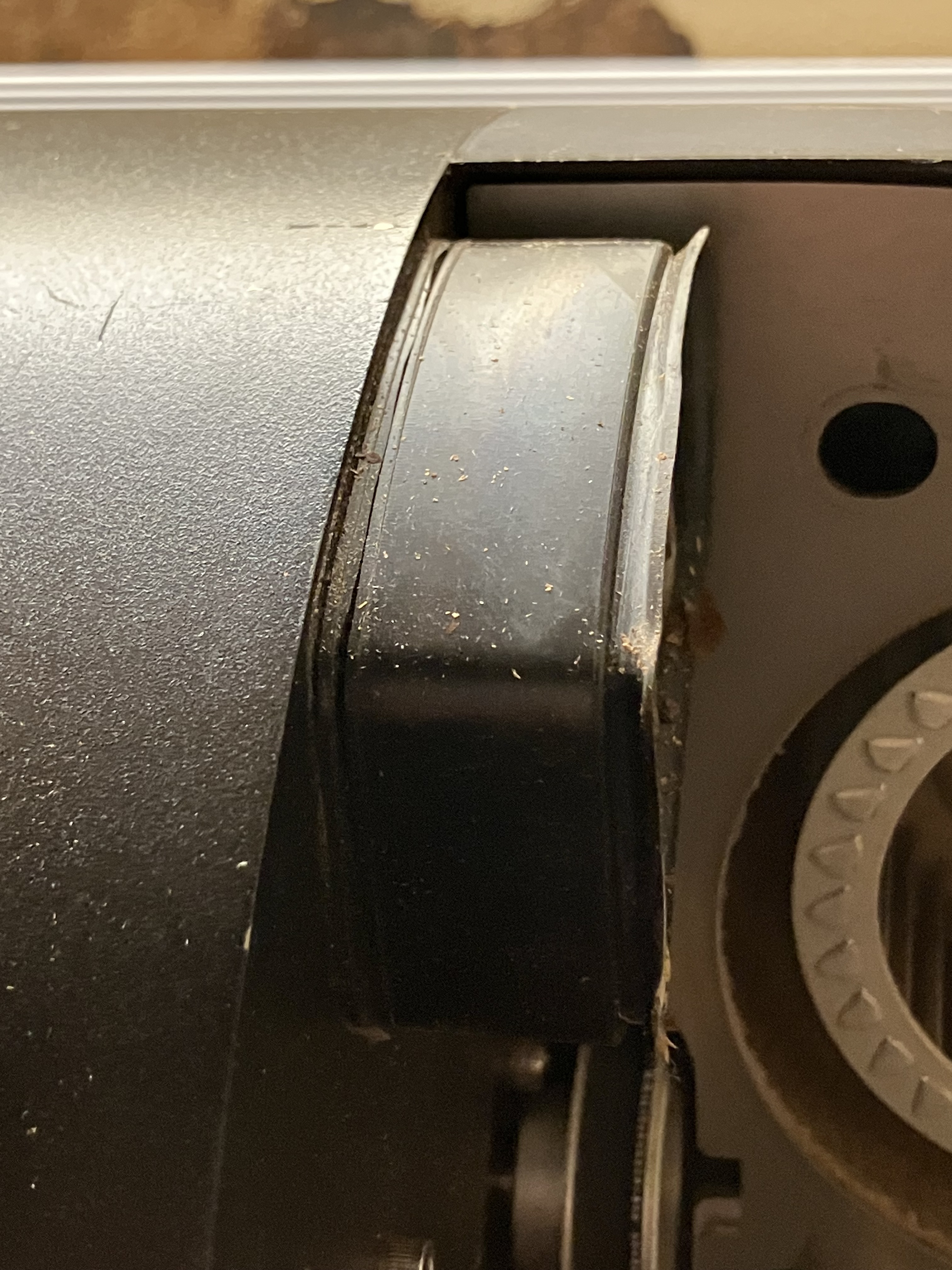
bit if you were wondering what more subtle aspects of parts effdct the roast, i can think of at least one of many smaller easily overlooked parts: one part on the Bullet that as very subtly off had some influence on my machine. the airflow shaft or tube that runs along the top of the roaster was a little short. just by a few mm. the very fine gap meant that the black rubber part did not make a good seal with the chaff box, and the escaping hot air would deterioriate the rubber seal rather quickly. i made a small adjustment and now that rubber part lasts a lot longer.

Yeah @jimmybulletroaster that was helpful and I appreciate this follow up response as well. I hadn’t thought of parts affecting roasts in the Bullet like this or improving ROR curves, etc. I’ve become a little disenfranchised chasing down beautiful ROR curves because some of the crazier curves have given me better results in the cup than when I’ve had perfectly smooth, descending curves.

1 Like

yes, when my machine had more issues, beautiful ror curves did not give me good results.

as i fix things and find things, i will revisit smooth ror curves and so on. in theory they seem to make sense, but they don’t often give a better cup. and i wonder how much of that is personal taste and how much of that is machine tolerances being different.

Just out of curiosity how did you end up fixing the rubber seal (and which adhesive did you use, if any)? Mine can be puckered up from the chute by squeezing it with two fingers, but otherwise still seems to be somewhat adhered to it. The outer edge deforms every time I remove the collector and reinstall it, it seems, I don’t know what I’m doing wrong.

i sliced an older rubber piece thinly and used a slice as a spacer, then added the new one. the spacer helped push the rubber seal onto the chaf box enterance hole.

if i make another one, i’s probably go slightly thinner. but even 1mm gap causes pretty quick burn deformation/shrinkage on the seal lip, and ends up leading to airflow issues.

not sure if this was the issue you had. but this is what I was talking about in myprevious post.

@adejanasz.uw3u

what was the issue you were experiencing?

It hasn’t failed yet, but the rubber gasket on mine is starting to separate from the transfer tube. I assume the factory applies some sort of adhesive that has weakened with repeated removal of the chaff basket for cleaning/emptying

1 Like

@adejanasz.uw3u

are you talking abput the glue that holds the transfer tube in place? or the black rubber seal that connects the chaff collection box to the transfer tube?