From P7 to P9
zzzzzzzszzzzzzzzccccccccccccccccccccffchccxsfcddfxdfcfgbcgbvhujghjbghbcgg
From P7 to P9
zzzzzzzszzzzzzzzccccccccccccccccccccffchccxsfcddfxdfcfgbcgbvhujghjbghbcgg
P7 seems mostly stable on my R1v2 and P8 variation is enough to trust it. P9 is a wildman, and horrible for consistent results.
Whoa that’s a lot of heat, OP. I think Morgan is right to suggest you try slowing down your roast. I panic if temperature deltas ever get above 14 celsius.
do you go by deltas?
there are few different theories that seem to create sort of preferences for primry input. Power, Fan, and Delta are the main three I see. I tend to be in the “Power” camp.
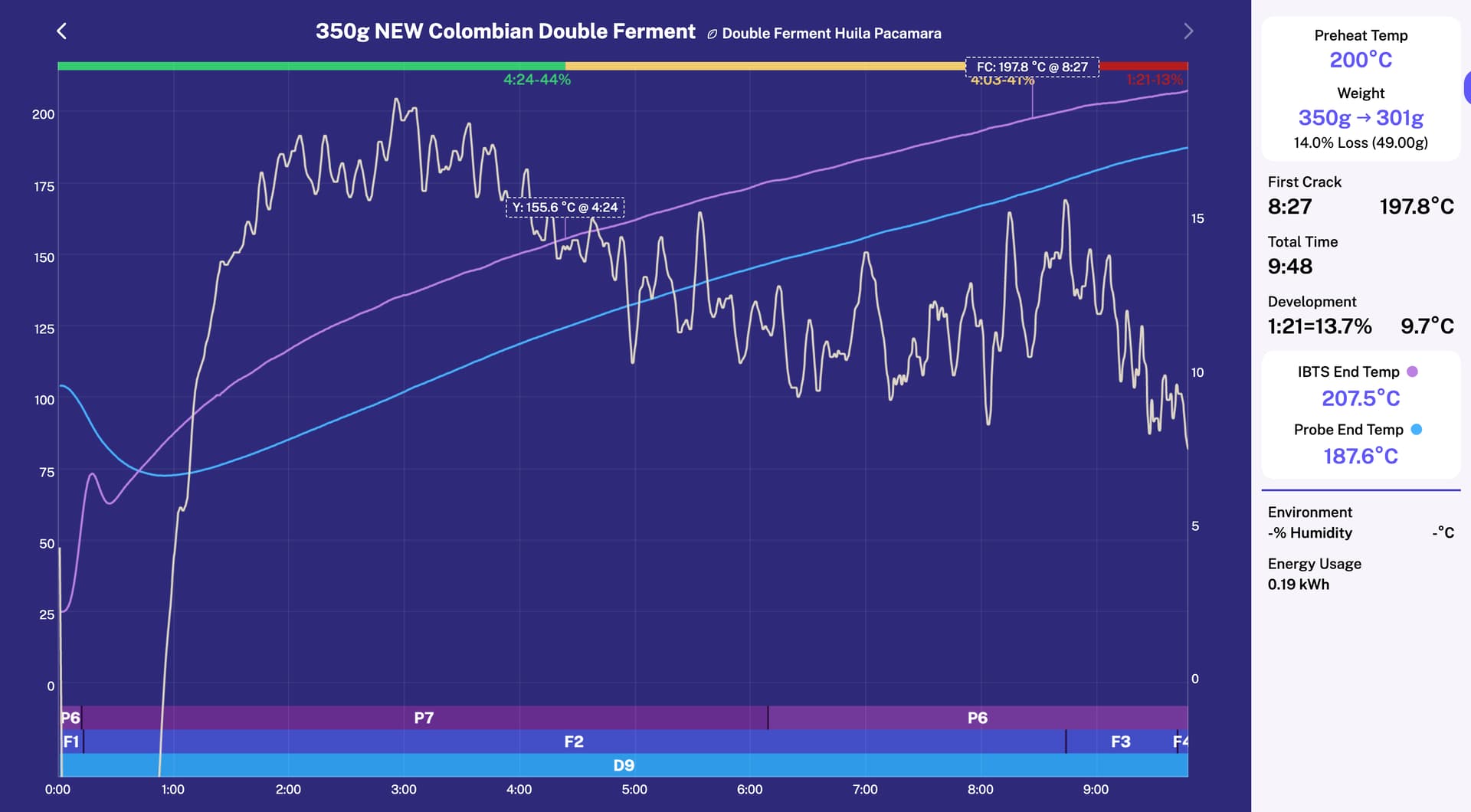
I apologize in advance, but I must ask why would you say that when development ran for 2m11s with DT of 12.9°C and took 30% of total roast time? Those numbers indicate overdevelopment, not under. Also, the beans have reached
Let me be clear, I’m not trying to prove anything, I’m just interested in an elaborate explanation. Also because the beans wouldn’t be underdeveloped with 10% and 5-6°C DT. Actually, light roasts have much shorter development that rarely goes over 10%, but usually less if it’s a faster roast.
Hi all. Very helpful feedback, and I’ve been incorporating it in the last two roasts. I’m still experimenting, but I got closer with this last 350g. I’m going to start doing 400g as kafcafe mentioned.
The previous batch - where I was at 11 minutes at the end - were clearly baked. I’ve never really experienced truly baked roasts to that degree, so now understanding what it’s like is a helpful learning lesson.
Mainly because the Development Time alone does not tell if the beans were well "prepared"for the DT phase. You could have twice the DT that you have here and still have underdeveloped notes in your roast or risk baking the beans). So what i mean by “prepared” is mainly what is occurring in the yellowing phase - browning phase we often called Maillard phase.
Basically the Yellowing-Maillard phase should be viewed as a conditioning stage. The DT phase often called the “flavor stage” is where the specific balance of sweetness, acidity, and bitterness is fine-tuned. But you have to have something to fine-tune first. I guess that would be the short answer. For a longer one if interested:
Sorry if sometimes i write obvious remarks, just trying to be as precise as possible.
So coffee cell walls are mainly composed of Cellulose, Hemicellulose and Pectic substances. After the “Drying phase” (even if it is not just drying per say like we label it) when the YP begins, Hemicelluloses and pectins begin to thermally soften and partially depolymerize reducing wall stiffness and increases permeability. A bit later in this Yellow/Maillard phase, chemicals components inside the cell like carbohydrates, proteins, lipids, acids, caffeine starts to change, denature, react. When proteins denaturation starts (cell structure is still intact) the internal matrix changes and amino groups are release that will later participate in the Maillard reactions. For example, Melanoidins are polymers formed when sugars and amino acids react (to heat) giving colors, aroma and flavor (so more at the end of the YP that some people also call the browning phase (Maillard)). When the previous phases are done correctly then the DT begins relevant (as well as the color to describe the roast degree, otherwise both can be misleading)
About the advice i gave regarding starting with a higher Drum (and BT) temperature charge here. First i have to say it is very difficult to give advice without knowing the beans characteristics and what you want to achieve. What i suggested is a guess for what would be a relatively large and dense bean. And it would be for a light roast where you can taste the fruit of the coffee, no biterness, bright acidity and sweet (as i drink mostly ristretto with no sugar, i need natural sweetness in my coffee). For me light roast means a BT temp drop of 203-205c (and DT would be around 210-212 on my bullet) for this type of beans. The important thing is not just the drop temperature of course but how you go there. I agree that for a darker roast, one would have to extend the roast to get a later FC and a higher drop temp. Finally specifically for the costa rica roast here, the Maillard is way too short for good sweetness and body (not enough Melanoidins created). Should aim 31-33%. But this also depends on how you mark the phases.
Yes the colombian (double fermented) is baked and other problems. Basically your temp curves are not convex enough. You will find that some beans are more forgiving and easier than others. If i remember well, pacamara is a cross with maragogype and another variety that i cannot remember. The beans are likely quite huge and can be very dense too (from Huila). I suggest to start with a catuai or bourbon or any variety grown in Minais Gerais in Brazil. Not very dense and generally very forgiving.
BTW is your RoR from probe (B-RoR) or infrared (I-RoR) ? (i suspect B-RoR) given the huge noises in there). You can activate both in chart settings. I find the I-RoR more useful to identify crashed, baked or stalled batches. And the B-RoR generally more noisy but better indicator for the drop temp at the end (given the desired roast profile). Anyway what are you trying to do (how do you like your coffee)? Do you know the density and moist content of your green beans? What is the size?
And finally do not get discouraged, you will succeed!
I’m sorry, this wasn’t what I was asking, but thank you for taking the time to elaborate.
I am sorry, not too familiar with this site and how to reply correctly (did some post 5-6 years ago). Does not let me reply twice to two different persons within the same post. Never sure who i am replying too.
Anyway, to braca19452f9m: You question was “why would you say that when development ran for 2m11s with DT of 12.9°C and took 30% of total roast time? Those numbers indicate overdevelopment, not under.”.
I thought that is exactly what i answered. The answer is: Because those numbers are relatively irrelevant in this specific case. They would be relevant if one achieved correctly the previous phases. Yes the numbers alone taking out of a specific context indicates overdevelopment no doubt. But obviously according to the taster, that is not what really happened here with this roast. I think (perhaps falsely) that the best instrument to know if a coffee is underdeveloped is your palate when you taste it. Not the tags, not the color or numbers one’s putting on curves. I was simply not surprised that according to the first post, the author said it had underdeveloped taste. Basically the development time DT (as well as time of the entire roast) will not tell you anything about the quality of the development time aka how well the beans are developed. It tells you the time, not what is happening during this time. I also thought that in my previous (more detailed) post, it was clear that coffee development did not only depends on the phase labeled DT.
To jimmybulletroaster, you asked “do you go by deltas?”
If I understand your question well, I guess I use delta. I usually drop when delta I-RoR is around 5. But that is not an absolute dropping condition or target for me, more an observation. What is important (according to my cuping results observations) is that the I-RoR is always smoothly declining. You can still have a more than decent cup without a “perfect” RoR but it depends on the lenght, intensity and timing of the “crash” for example. Not sure what you mean by “power camp”? But I think i am in no specific camp.
You can select and quote a part of conversation, or you can put @ in front of the user to which you are replying. You could also select the username, next to the profile icon in the post, and copy/paste it in your post. Select with the mouse holding down the left button and a small menu will appear above your selection, containing 3 options. Just select “Quote” and it will automatically add it to your post at the text cursor point, which you can also select.
Well
As I’ve said, I don’t really want to prove anything, but it seems you want me to explain, so I will. Keep in mind that neither mine nor your view is the correct one. The palate is a subjective, not an objective measurement. The best way is color measurement. Even better, when suspecting underdevelopment, would be to cut the bean in half and see for yourself. All the chemistry and breaking down of everything that you wrote happens at certain temperatures. It will break down one way or the other, otherwise, fast roasts would not be possible. Also, the bean probe is useless on a 300g batch. What I see from the graph is that there was a rapid decline in temperature after first crack, which matched the decline of the entire roast. Dumping the beans earlier without dropping the temperature that much is how fast roasts are done. The roast would have developed normally that way. Call it underdeveloped, call it baked, which is my preference in this case, the main culprit is long development time with low temperatures. He went from 25°C to 198.3°C in 5m24s, which is a 173.3°C rise, and then went 2m11s to reach 211.2°C, which amounts to 12.8°C. Reaching that temperature in a fast roast should be done without dropping the heat so much and dumping the beans earlier. Even a longer roast should not lose that much heat after FC, but be steady at a lesser temperature. Whatever it is, we might ask @cosgood.CqHb to take a picture of the external part of the bean and the bean cut in half for us. But I would really like not to prolong this and leave it the way it is, meaning that everybody’s right and nobody’s wrong.
P. S. By the way, if I were to try your 400g profile, I’d burn my beans beyond recognition and have all sorts of other defects, even on the densest of beans I have, which do go around and even beyond 0,73g/ml you mention. I guess my Bullet may be stronger or my power grid is more stable, Whatever it is, I’m sure I’d reach 1st crack in 4 minutes or so.
Thank you for the indications on how to message. Maybe also i am on my phone not computer. Very helpful.
I agree with all you wrote (and i do not find it incompatible with what i wrote). And i am not the “right” or “wrong” arguments type of person. Me i did not see any sign of obvious baking in the RoR after FC. On the contrary, as you very well explained the temp went down too fast after FC which could also have stalled the batch, so even with a 30% DT, it is underdeveloped because it has not developed during the DT. So the DT means not much here and the color likely misleading (on the quality of the roast). Still just a theory not the absolute truth. To my palate baking does not taste like underdeveloped. And you are right the palate is subjective, that is why i take the brix right after the roast. Anybody else does? When i get around 4,7- 5,3 Brix (depending on the type of beans and for 30g cup;using 10g puck), i know why my palate is telling me it’s a success. I guess what i am trying to say is that the color can tell me the roast development degree but not if the coffee is good or not. Although subjective, my palate and nose can tell me if i enjoy the coffee or not. And for me that counts more than any measurement (or curves shape).
On another subject, any of you experimented with the effect of ambient humidity on the roast and its effect in each phase? I haven’t found any specific topic on that, just few posts. Do you think it would be worthwhile to start one ? Or this is an already set “debate”?
Don’t apologise. Your comments are most fascinating to read (the more detailed/obvious the better, as far as I am concerned), and reflect not only years of experience, but deep skill of observation.
… and you have done a PhD in coffee roasting?
I just wish I had a Bullet to jump onto and start experimenting with…
OK, it’s just a potato-potato tomato-tomato thing, but it’s not conveyed very well in writing. Maybe colour-color thing? I call loss of energy and protracted roast, which reached a certain temperature, baked, you call it underdeveloped. I don’t really care, so that’s settled.
What I’m saying is that another person might be of another opinion when it comes to tasting. And we’re not talking about good coffee, but about what went wrong, and neither of us is tasting the coffee. Seems a bit futile. Let’s not talk triangulations, the game is on soon. Also, if you measure the whole bean colour, or just look at it, although it is better to measure it, and have a large discrepancy with ground colour, then you know, not speculate. As for humidity, it is obvious that coffee needs more energy to dry in high humidity roasting. But that’s once you pass 50-60%, although the Bullet, or any other roaster, along with smoke extraction, will lower that by at least 10% after PH. I wish you a nice day or night, whatever time it is where you are. I’m off to watch the game.
I really wish! no in mathematics. But i like to read biochemistry articles in journals that are about coffee or food in general. For exemple if you “google scholar” this title: “Chemical changes in the components of coffee beans during roasting”, i think you will have access to the article in pdf for free. The difficulty is to translate the knowledge into practical applications while roasting. I read more complex articles only on Melanoidins polymers and that is where you realize that we do not fully understand the chemical reactions happening while roasting (especially in the Yellow-Maillaid phase). But we will one day.
You are correct it was the B-RoR, so I switched it to I-RoR to see how that goes.
This is exceedingly helpful. Thinking of the earlier stage as “conditioning” I find very helpful in how to think about it.
In terms of extending the Maillard time, are you saying 31-33% of the total roast time, or is there an absolute time that’s best? 1 minute, 2 minutes, whatever?
And what about the temp ranges for where the Maillard is occurring? I’ve heard around 175C to 195C where FC starts to happen. If we are conditioning for FC and DT, then what RoR, temperature, etc. should I enter that Maillard phase to make sure I develop the most robust sweetness?
I’m going for the same profile. I like a lot of fruit, balanced acidity, touch of bitterness and rounded sweetness if that makes sense.
Very helpful again, thank you.
One could actually get a PhD in food science… I digress.
I do think there is a difference between underdevelopment and “baking.” It of course depends on what terms we use. I could also see underdevelopment being a more generic term and baking being more specific. However, I believe underdevelopment means not enough time allowed for the bean to “cook” thoroughly, as in each individual bean being roasted through from surface to center. I believe “baking” refers to not enough heat applied over the course of the roast, so that the malliard reaction is stimied. I think part of the reason it is called baking is that in baking the goal is often to avoid a malliard reaction.
Also, thought I would add that I have made several posts recently about the thermodynamics of cooking. I have not included very many technical terms in my explanations, but hope that it is helpful as it has been to me:
David
My joking “PhD” comment to kafcafe was meant as a compliment and I can also extend it to you and a few others here on the forum.
I just really enjoy reading these posts as they impart so much knowledge that I otherwise would have to gain through massive investment of time and frustration (once I actually have a Bullet).
Funny enough, I enjoy reading both kafcafe’s at times more technical posts (e.g. “The coffee cell walls are mainly composed of Cellulose, Hemicellulose and Peptic substances…”) as well as your succinct explanations in layman’s terms.
So thank you increasing the angle of my roasting learning curve, David - really appreciated!!!
For me to do a PhD in Food Science?!?
That would take shitload of coffee!!! 
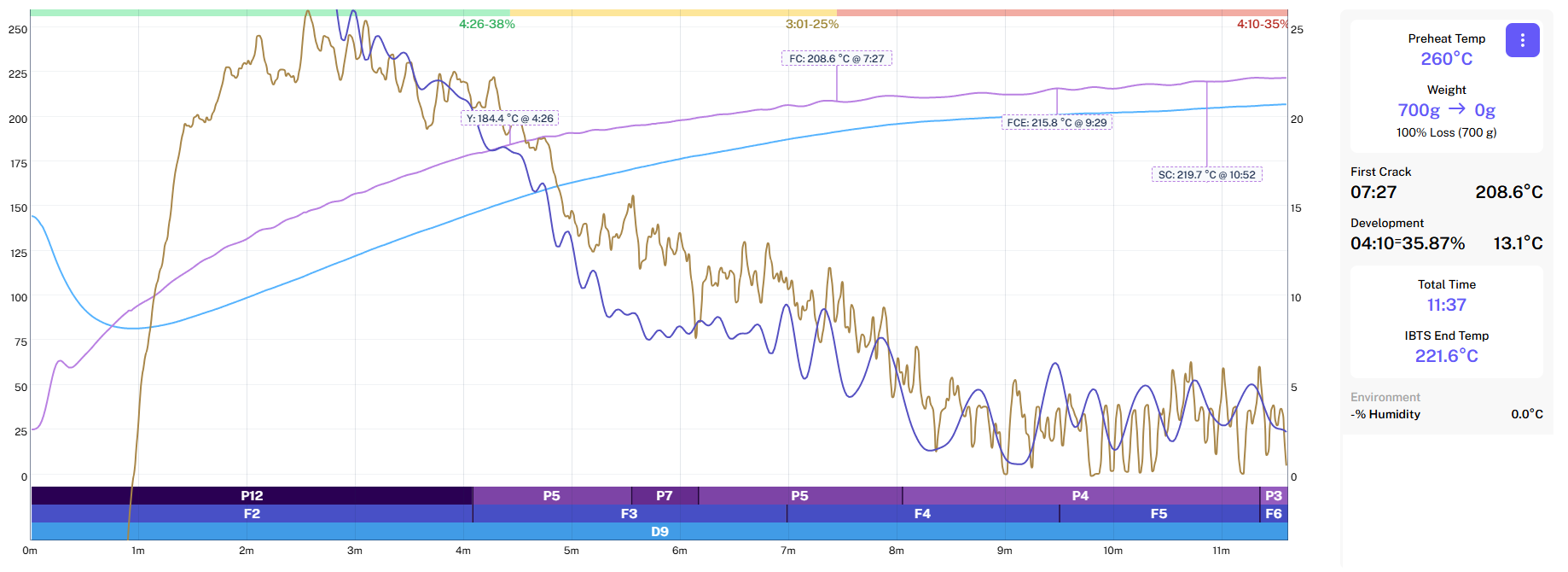
I’m in a similar situation. Over the past 7 years, I’ve grown from Genecafe and Cormoroant CR600 to Aillis. 7 roasts on R2 and I still haven’t been able to replicate a great espresso roast. Great roaster, very powerful, with a lot of potential, but a unique machine and definitely not copy/paste logic compared to a classic drum roaster.
I’m attaching one of my last profiles with agtron values. The profile graphics are not bad, but the result is underdeveloped. During roasting, the beans quickly changed their external color, but the chemical reactions inside took place much slower. The DryEnd color is uneven. The sound of the beans cracking is ambiguous. 1C is clear, but 2C is unclear (not sure at all it happened).
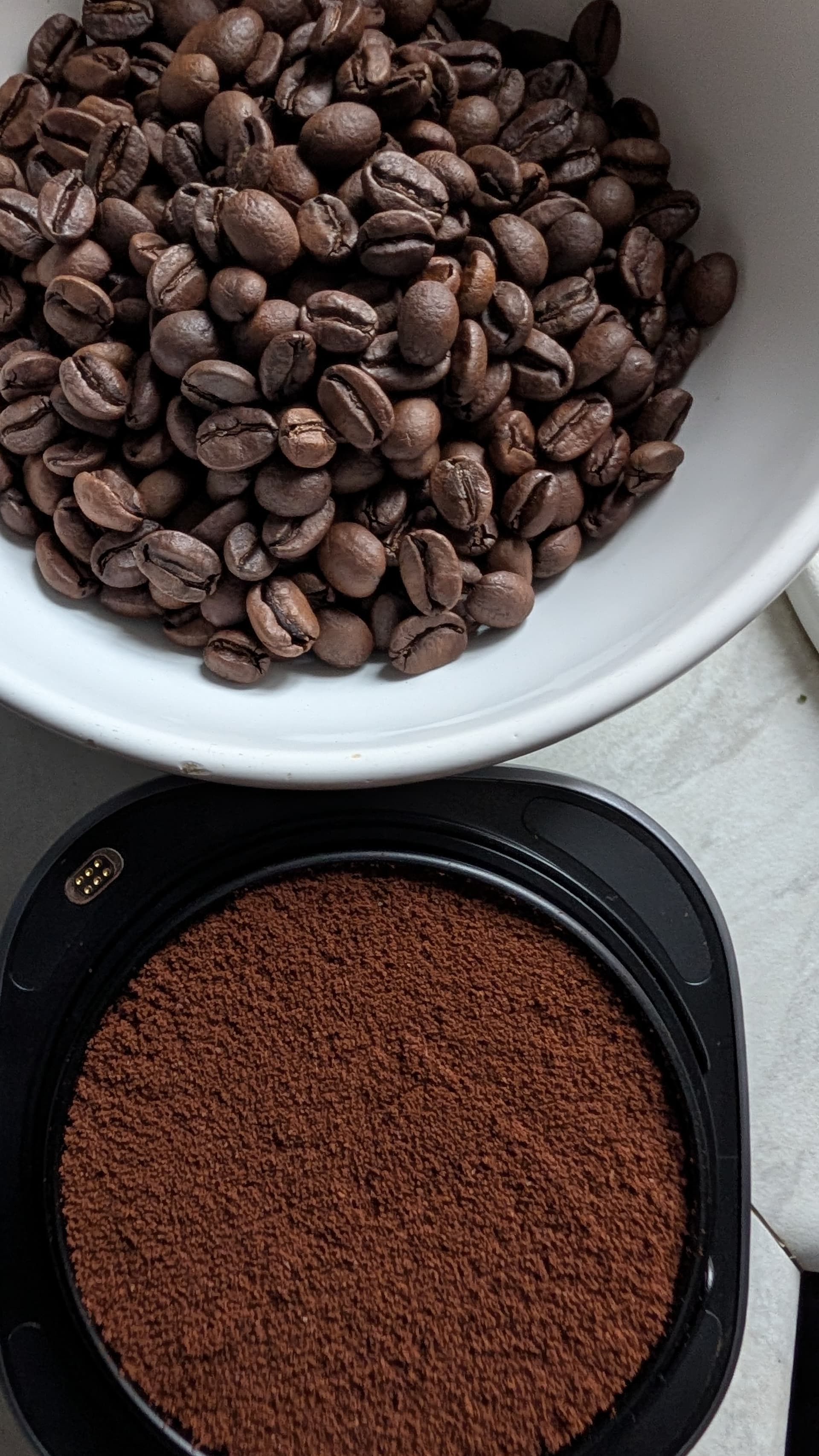
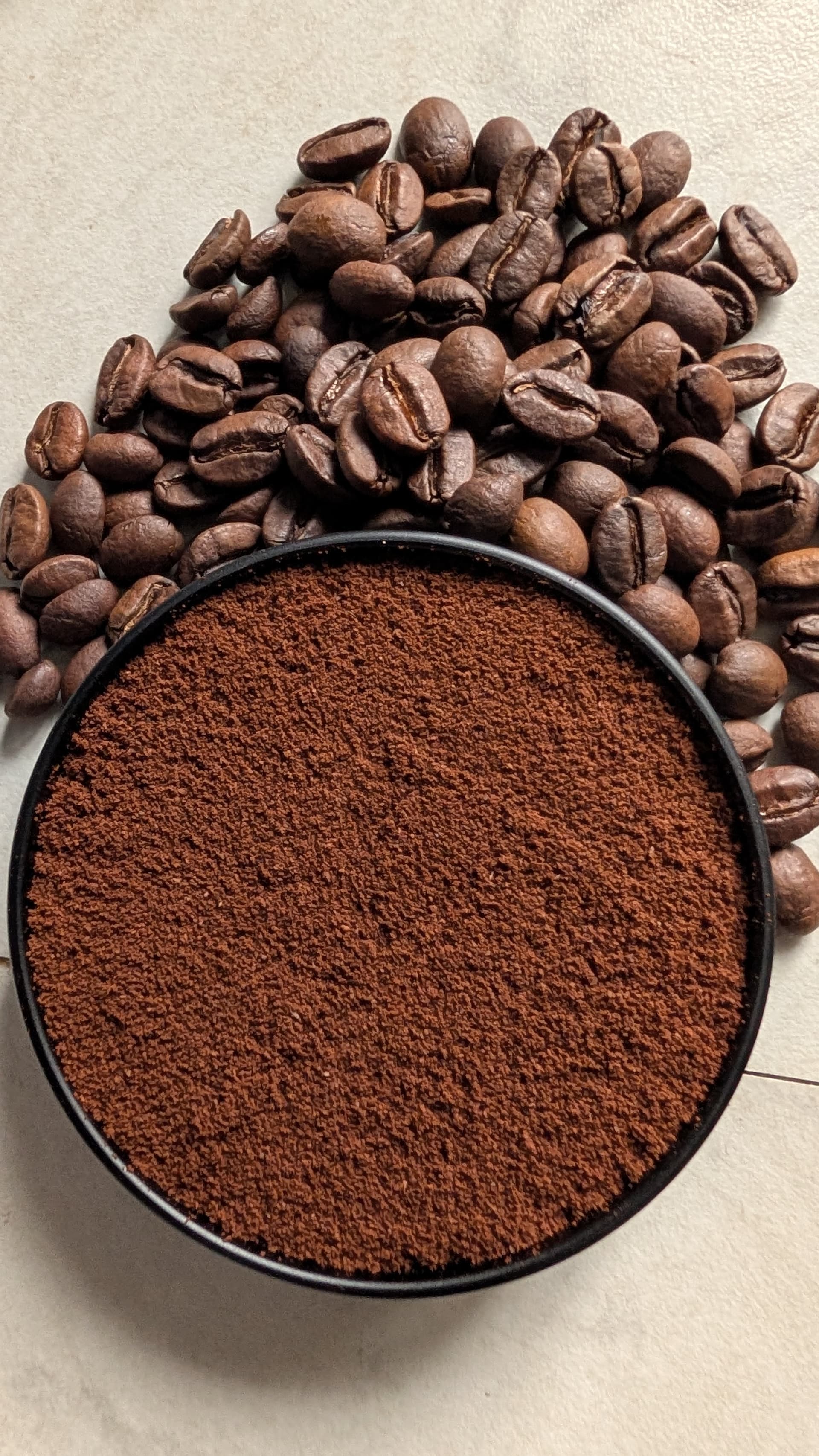
The color of the beans according to agtron is 53 (Medium or City+), and after grinding I got a value of 90 (Light Roast). So I’ll have to slow down a bit.
And thanks to everyone who shared their insights and comments in this topic. There was a lot to think about, so I can’t wait to try new adjustments to my recipe.