New R2 - Questions on astringency, under-development

Hi all -

I researched what I could find on this topic, but I’d appreciate some perspective on the results I have after my 7th roast (including the 3 seasoning roasts).

I’m mainly an espresso drinker (Lelit Bianca), but I’ve been roasting for years. This is my first drum roaster. I had an old fluid bed roaster many years ago, a convection oven + popper that I had put together, and most recently a Behmor.

In all cases, I’ve had consistent and good to sometimes great results. So far, in the R2, I’ve had roasts that are what I’d describe as astringent. Tannic. Flat.

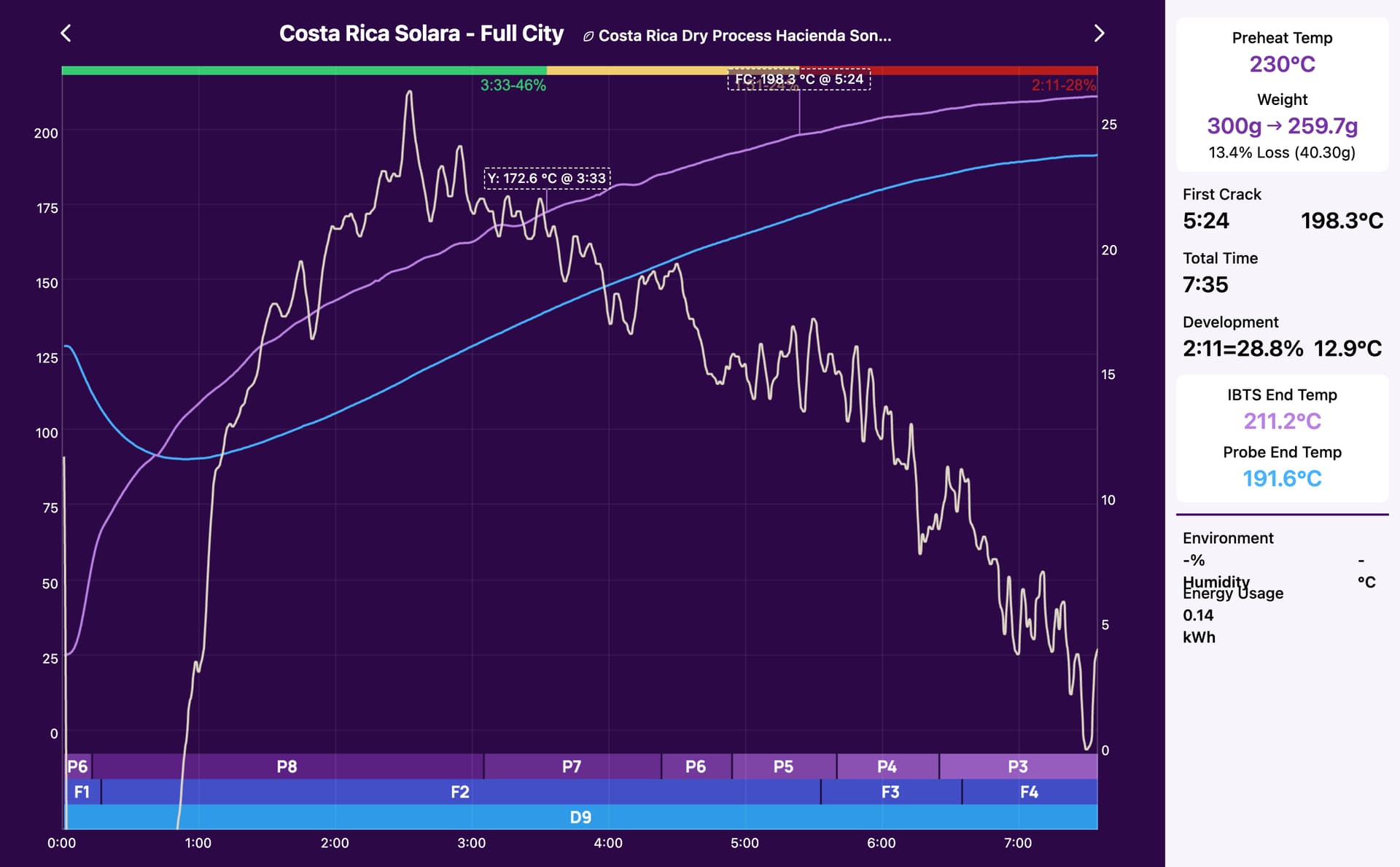
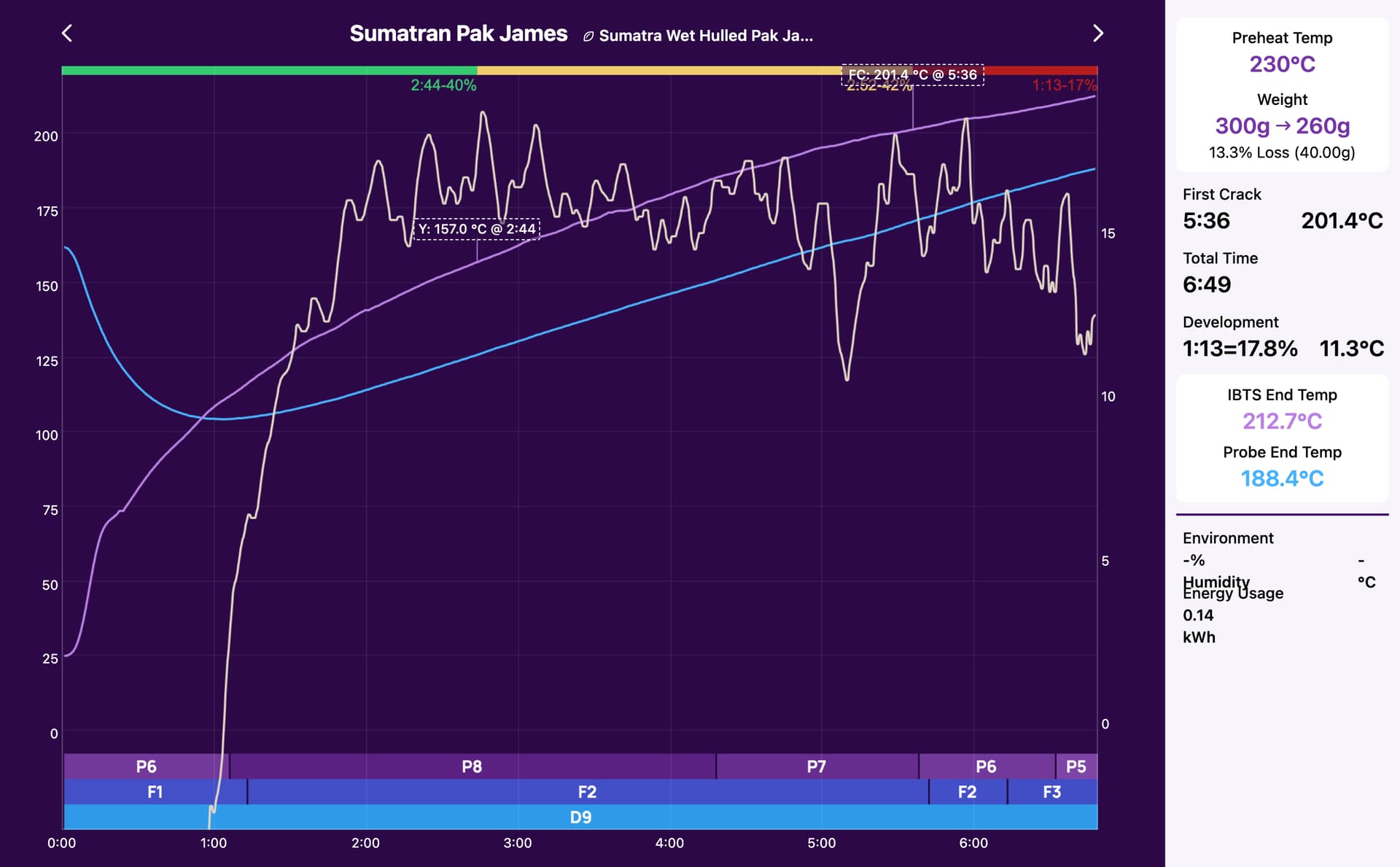
I recognize those are signs of being under-developed. I included my last two roasts to give you a sense of things.

The weight loss, the development time, etc. seems like it would indicate that the roast would be developed. The color does indicate more of a Full City roast level, but I understand (correctly?) that color as a guide for drum roasters could be misleading.

Could it be that it is actually developed, but there’s another issue involved?

Given my past success with other roasters, I’m a little concerned that I’m getting these results. I’m of course ready and willing to invest the time (already invested the money), but any guidance and direction would be helpful.

Thanks!

In the context of roasting for espresso on a drum roaster, the first thing I see when I look at those profiles is how fast they are. The second thing I see is how short the development time is.Drum roasters almost always take longer to reach a given level of development than air roasters.

I know there are a lot of third-wave roasters who are really pushing shorter times to first crack now, but the advice I’ve been given by the old school is that longer times to first crack result in more complete internal bean development, and a smaller spread between the internal color and the external color. The spread, and not the external color, might be the source of your flavor problems.

And most things I’ve read (and in my limited experience) indicate that sufficient post FC development time is needed when you’re brewing for espresso.

A given color can be achieved either with a higher end temp and a shorter development time, or a lower end temp and more development time.

Now for the personal opinion part: I would personally try to stretch first crack out to 9 minutes or more, and apply at least 2:30 in development. I think that ending at 213C (which is lower than my usual), you really must ensure adequate internal development and post-first crack DT.

FWIW, I recently roasted a delicious natural Ethiopian to a similar end temp, but took my time getting there. The espresso was a bit high in acid for my taste, but extracted well and had a lot of really nice characteristics.

Last thought-- I would try to avoid over-emphasizing temp comparisons between roasters, even the same model. It’s much more useful to use them as a guide to reproducibility on a given machine, with a given bean, etc.

the Bullet is perhaps the opposite of air roasting. so you may have a short learning curve ahead.

also it may be a drum roaster, but it does not roast like a gas/flame drum roaster either. the Bullet is sort of its own thing, for better or worse.

Would be interested to hear your thoughts coming from air roasting to Bullet, as there is likely to be some unique aspects about both.

That’s helpful, thank you.

I’ll take your recommendation and try stretching first crack out to ~9 minutes and extend the development time. Will report back.

In my experience with the air roasting - for at least the more consumer-focused roasters - is less control, less power and therefore less ability to influence the timing of the roasts.

On the Behmor, for example, I’d typically need anywhere from 12-15 minutes to get to FC for 400 grams.

I never had this astringent character. They always cupped clean, fruity, low roast character unless roasted Full City+ and beyond, and rarely any defects.

1 Like

yeah, induction is pretty reaponsive. in terms of conductive energy from the drum, it is potentially the most reaponsive. but in terms of airflow, which is arguably more important for coffee roasting, the airflow is pretty laggy.

Just to be clear, you can make espresso with any roast type, style or level. If you ask those that want to say it, they’ll tell you that the roast level is just to facilitate the barista’s work. Espresso is a brewing thing not a roasting thing. Since you’re at home, as far as I understand, you don’t need to be efficient and fast when making espresso. So, it will be a taste preference, not the roast level.

Although you’re using the R2, which I haven’t used, 230°C PH seems a bit excessive for 300g.

The Costa Rica might be baked, as there’s a significant drop in temperature from FC to end of roast. The colour is important, but not if you bake your coffee. You can read more about it here, and the example given there looks very much like your screenshot. Don’t make too many adjustments post FC. It’s better to drop earlier than to bake the coffee.
What is Baked Coffee? (MOST PROS DON’T KNOW!) — Scott Rao

As for the Sumatra, it has really gone wrong in many ways. What you should do is concentrate on specific targets and hit them without having to overcorrect. This means lowering the PH, starting with lower power settings and not making too many adjustments. This is for the 300g batch. When you increase the weight, you must act accordingly with your PH and power settings. Personally, I wouldn’t change the fan settings. If you want, you might crank it up a couple of seconds before drop, but during the roast the change in fan settings gives wild swings.
As morgan said, you want to extend your roasts, but I don’t think 9 minutes FC would be good with such a small batch. That timing should be applied to 500g or more. But that’s just what I think based on what I saw. It isn’t something you should blindly trust. Maybe some people have success with roasting 300g batches on the Bullet for over 11 minutes.

One last question. Have you measured the colour or are you just eyeballing it? When you’re just looking at it, you won’t know if you have the problem of internal underdevelopment because, as morgan said, the inside could be a lot lighter, and there’s no way of knowing other than measuring.

Anyway, take all advice with a grain of salt, or just as a starting point, and try to find your own way.

1 Like

There are lots of opinions out there, and a lot of anecdotes (including the one I shared) about what works and what doesn’t.

One of the most refreshing perspectives I’ve read on this is from Morten Munchow, who’s done a lot of work on correlating the manipulation of roast inputs to outcomes that people can perceive. His thesis is this: In the end, what you can taste in the cup is really the thing that matters, and only things that drive those outcomes matter in roasting.

Munchow is, like Rao, a consultant who sells his expertise-- that’s important to remember. The rational thing to do is not to take recommendations as prescriptive.

I agree that the most important thing is to experiment, take notes, and learn from your successes and failures. What works for me won’t necessarily appeal to you.

Great article. That helps.

True, the PH on the smaller batch I now see was too high, so I was over-compensating (using RoR as the guide) and that caused some of the volatility in the RoR as I was lowering power to bring it down.

I’ve never accurately measured temperature at all in my prior roasting experience, and instead went based on smell, color and just intuition.

No, I’ve never measured the color. Just experience and charts. I thought a refractometer only measured the external color, but are you saying there’s a way to measure the internal development more directly?

Fair point. As mentioned in my other post, this is the first time I’ve really had any meaningful data available to me.

I definitely found myself in the mode of trying to correct the progress of the roast through power and fan, based on what I had understood was more of a need to manage RoR, Maillard time, development time, etc.

I’ll find a more natural balance with it in the next few roasts and see where that gets me.

Also, I completely destroyed 1.5 pounds of coffee in an earlier roast, so that’s why I switched to 300g but I didn’t lower the PH.

I’m thinking:

  1. Lower PH for 300g
  2. Less manipulation of power
  3. Keep fan consistent (I like that suggestion)
  4. More development time

I’ll see where that gets me.

Thanks!

Here is a recipe to try and change based on your own style.
Make sure you mark yellowing and first crack. I had the same problems when I first started Aillio Drum roaster from Behmor. It’s also hard to apply professionals recommendation to Aillio. Concepts from all have to be adapted to your location, beans, and style. The things that seemed to help with underdeveloped internal bean structure is increase time before yellowing, and time from yellowing to first crack, of coarse anything done to long has negative effects; therefore I posted a recipe I use often and modify based on bean and brewing style. This recipe is for 750g, so keep this mindful if using on anything below 500g or above 1000g.

RW Recipe for 750g Roast