Hey I like that high temp silicone stopper idea. I’ve been using a similar setup with a brass pipe fitting ever since I saw it on here way back when. Wondering if you still use the bean tryer with this setup? Can you put the stopper in and out easily?
Pretty much impossible for me to hear soft cracking beans without this.
@billyjackskin.Tdzn I don’t use the trier at all. At this point I rely entirely on my roast recipes, which have gone through multiple iterations and tweaks, with some AI assistance along the way, so the trier just isn’t necessary in my case.
Another reason I avoid using it is that every time the drum is opened to outside air, it affects the roast. The cooler ambient air rushing into the drum will pull temperature down, and you can see that immediately in the roast curve.
But yes, the stopper is fairly easy to remove. The only caution is that if you pull it during a roast, the surrounding metal will be very hot, so you need to be careful.
I don’t use it either. It’s really too small I think. Was just curious. I always see the Aillio guys using it though. I don’t run too many recipes because it seems like I always have a new bean going. A lot of peeps here will say you don’t need to hear FC as you can tell by the IBTS when it’s occurring which is true but I always like to listen and mark it when I have a good consistent cracking starting. I kind of doubt we’ll ever see the Aillio guys with a stethoscope but I can’t go without it now. 
@billyjackskin.Tdzn Same here. I roast a lot of different beans too — right now I’ve got more than a dozen greens on hand from all over the world, and most of what I roast goes out the door to friends.
My experience has been that you really can’t depend on IBTS alone as a marker for first crack. Even with the same bean, it can shift depending on ambient temperature and humidity. I’m not looking to get into a debate about it, but that’s what I’ve seen from hard empirical data over a lot of roasts. For me, the stethoscope pretty much ends the debate. It lets you hear exactly what’s happening instead of inferring it indirectly.
What’s been interesting is that, with AI helping me remove so much of the guesswork, even on a new bean I’ve never roasted before, the first roast recipe now usually lands very close to where I want it.
If you haven’t seen it, check out my other post about using AI to help tweak recipes.
1 Like
I have had good success putting my ear right next to the hopper plug. As I near the suspected time of first crack, I slightly lift the hopper plug as if it were on a hinge…every 5 seconds and I only open it a tiny crack for a moment to make sure air doesn’t rush in. Any air that may rush in will be just part of my routine curve. Not sure if it is my imagination but also seem to feel the vibration of the cracks with my fingers on the silicone plug.
3 Likes
@franzusa, I used to do the same thing, but I eventually got tired of lifting and closing the hopper plug over and over. That’s what led me to come up with the stethoscope mod, and it has improved my results quite a bit.
What I’ve found is that when a bean reaches the point where the remaining moisture turns to steam, it expands and causes the crack. But the first beans to reach that point do not always give a sharp, clean crack. Quite often, if the structure is weaker, they make more of a faint thump than a true crack.
Those are exactly the subtle sounds the stethoscope picks up well, and in my experience they are not possible to hear reliably by briefly lifting the hopper plug. So if your method is satisfactory for you, that’s great, but for me the stethoscope has been a real step up.
Dear carldebar,
I have fixed a sthetoscope like you suggested and I did my first 3 roast with it. It is amazing!! I had trouble with some beans (especially Brazilian) to determine FC. Now I can hear every crack, also when in the back of the drum. So for the first time I can clearly call FC when I want. (at roling crack, so not singular cracks anymore but at least 4 or 5 very close together) . I read a lot about this but finally I understand and can hear it consistantly, thanks to you and the stethoscope! I also roast many different beans but small quantities, so every roast has a different time and temp to FC. What I focus on is delta time and delta Temp after FC. I did a lot of experiiments with this and I seem to like de delta time about 1:15 to 1:20 and a pretty high delta Temp of 8 to 9 degrees (Celsius). I also do not use the trier and ROR is less important for me then delta time and delta Temp after FC. I calculated my own roast profiles not with AI but with regression techniques (LN an root functions) I think that is fun and I am a little weary of AI because I do not know the source of information an had a lot of nonsense with it (AI insists Ground bean color is always darker then Whole bean color???)
Thanks a lot this stetoscope will improve my roasts and my experiments with roasting!!
Oscar
1 Like
@oramspek.f7aJ
Oscar, thank you for the feedback. I’m very pleased to hear how much this has improved your confidence in calling FC. It has been a real game changer for me as well.
Your delta method makes a lot of sense. It is a reliable way to measure development because it focuses on what happens after FC rather than depending too much on absolute time or temperature, which can vary quite a bit from bean to bean.
What I’m actually doing now is something of a hybrid between DTR and delta. I use DTR as the primary target, but that target is different depending on the bean. Then I look at post-FC delta time and delta temp as a secondary check to confirm that the roast finished the way I intended. So in that sense, I’m not relying on a one-size-fits-all DTR, but on a bean-specific DTR with delta helping validate the result.
I also agree completely that being able to hear FC clearly changes everything. Once you can hear it consistently, a lot of the guesswork disappears.
@oramspek.f7aJ
Here’s an example of the kind of feedback I get from Grok when analyzing a roast.
This is an excerpt from a first-time roast yesterday of Burundi Dry Process Kibingo in high ambient temp:
“Bean-specific DTR (20–25%) remains the primary endpoint target. Here the actual 25.4% is only 0.4% above the upper tolerance, which is well within acceptable variance for a first roast of a new lot. The secondary corroboration metrics — development time of 3:08 versus a 2:30–3:00 target, and delta temp of +47.8°F — are in strong agreement with the DTR. The slightly extended development window and corresponding temperature rise reflect predictable hot-weather phase compression rather than any momentum problem, bake, or under-development. No conflict exists between DTR, delta time, and delta temp; all three confirm a properly shaped, gentle finish that maximized caramelization and body without scorching or rushing the endothermic dip.”
That kind of analysis has been very useful for me. I use bean-specific DTR as the primary target, then delta time and delta temp as a secondary check. It helps confirm whether the roast really finished the way it was intended to. Check out my post at Using AI for Bean Selection and Roast Graph Analysis
1 Like
This is an excellent idea and thanks for it. For several years, I’ve been using the “crack the bean chute plug slightly” to hear first crack. it works flawlessly 98+% of the time.
Have you tried putting the stethoscope in the bean chute in place of the plug? This leaves the trier hole open for the trier.
Interestingly, I visited the Coffee Center at the University of California, Davis last week. They have a number of large commercial roasters. While there, they did a demo roast for us on a Loring. It doesn’t have a window into the roaster to see the bean color and it was too loud to hear FC. They largely use bean smell and color from the trier. I’m the guy in green…
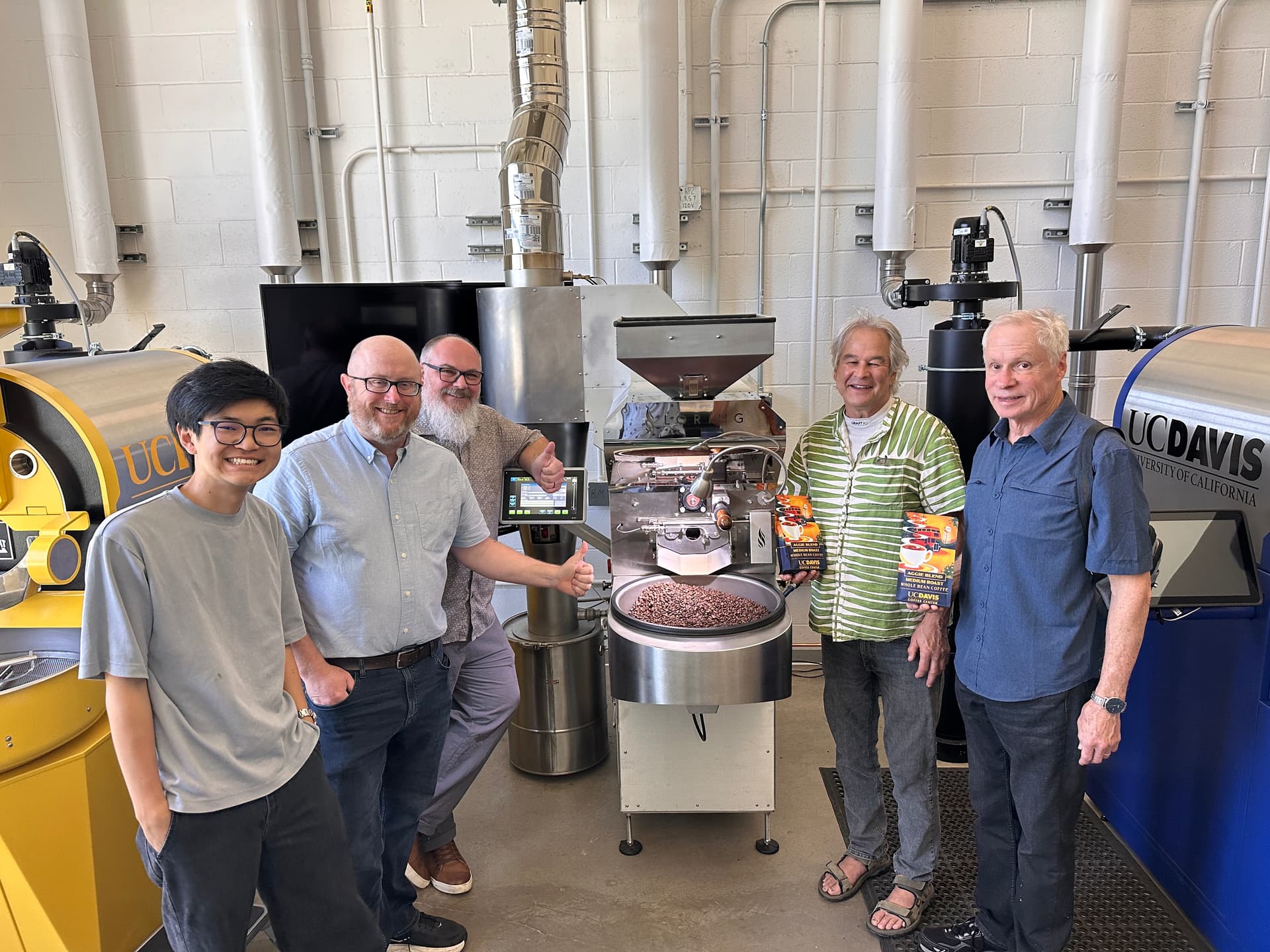
As a BTW comment, They have 2300 students take their classes and the director told us it’s the only university-based research center in the US. It’s the most popular class on campus. UCD has about 32,000 students
https://coffeecenter.ucdavis.edu
Thank you, I appreciate that. I have not tried putting it in the bean chute in place of the plug. My thinking was to keep the bean chute closed and use the trier port instead, since the silicone stopper gives a snug seal and seems to create a very clean acoustic path into the drum.
I also do not use the trier, so leaving that hole occupied is not a drawback for me. At this point I rely on the recipe and the roast data rather than pulling samples during the roast.
Very interesting about UC Davis. That makes sense on a commercial machine like a Loring where hearing FC is not practical. In that setting, smell and trier color would obviously become much more important.
Sounds like a great visit.
It would be an interesting experiment to try the stethoscope in hte bean chute. I know it won’t seal well but you could try it anyway. I literally just hinge up the plug and listen . For most every coffee I’ve roasted, FC is so obvious, especially when you get your ear close. The plug is only partially open and for well less than a second so not much heat escapes. Also air coming up the bean chute destine to exit the roasting chamber anyway so any heat lost is quite small.
I’d be interested in the results of using the stethoscope in the bean chute if you do it. I’ve never read of anyone doing that.
Cheers. Michael
Thanks, Michael. At this point the stethoscope setup has worked so flawlessly for me that I really do not prefer to open the bean chute at all.
My own view is that, if you were to try the stethoscope setup, you would probably come to the same conclusion I did: it is far superior to listening at the chute like I originally did. It picks up subtle early sounds much more clearly and consistently, without having to interrupt anything or put your ear in position at just the right moment.
So I have not felt much need to experiment with the bean chute approach further, simply because the current setup is already working so well.
By the way, if you’re interested, check out the roast analysis app I built here: A Roast.World / RoasTime Analysis App for the Aillio Bullet (Upstream Logic & Recipe Tracking)
Thanks CarlDeBar. The bean chute experiment was really for my benefit, and perhaps others, since I use the trier a lot. This is because I roast outside so in sunny, warm weather, I roast in the shade to keep the controller from overheating and shutting down the roaster mid-roast. But the shady environment makes it difficult to see the bean color thru the window. So I use the trier to capture some beans, then I walk a couple steps to see the color in the sun. Hence my request.
I’ll look at your analysis app tonight. Thanks for all your posts and responses. Cheers. Michael
The stethoscope in the trier port doesn’t work for me, all I hear are the beans moving around. First crack is clearer without the stethoscope, is there a trick to it?
@dmarkoulakis.K6KM
Great question, and thanks for asking. Did you cut the pickup tube down to about 2 inches? If not, that is probably the issue.
If the tube is left long, it extends too far into the roasting chamber and the beans will strike it. That creates a lot of noise and prevents the stethoscope from transmitting the crack sounds clearly.
The key is to shorten the tube so it does not extend into the chamber. It should look like in the picture I posted, where the tube ends right at the face of the part of the stopper that goes into the trier port.
Try that and let me know if it solves the issue.
Yep, that worked. I really had to jam the silicone plug in the port too before I could hear the cracks. It does work quite well especially for the beans that don’t make too much noise.
I take it back, it reduced the noise significantly but I can still hear the popping much more clearly without the stethoscope iny ears. I think it might still be too noisy for me to hear the pops
Did this set up after reading your post. Hearing is not as crisp when you approach 60, but this works excellent. Thanks for the advice.
That’s great to hear — thanks for letting me know. I’m older than you are, so I definitely understand the “hearing is not as crisp” issue.
Anything that gives a cleaner and more direct signal really helps. I’m glad the setup is working well for you. For me it has made FC and SC much easier to identify consistently, especially on quieter beans.