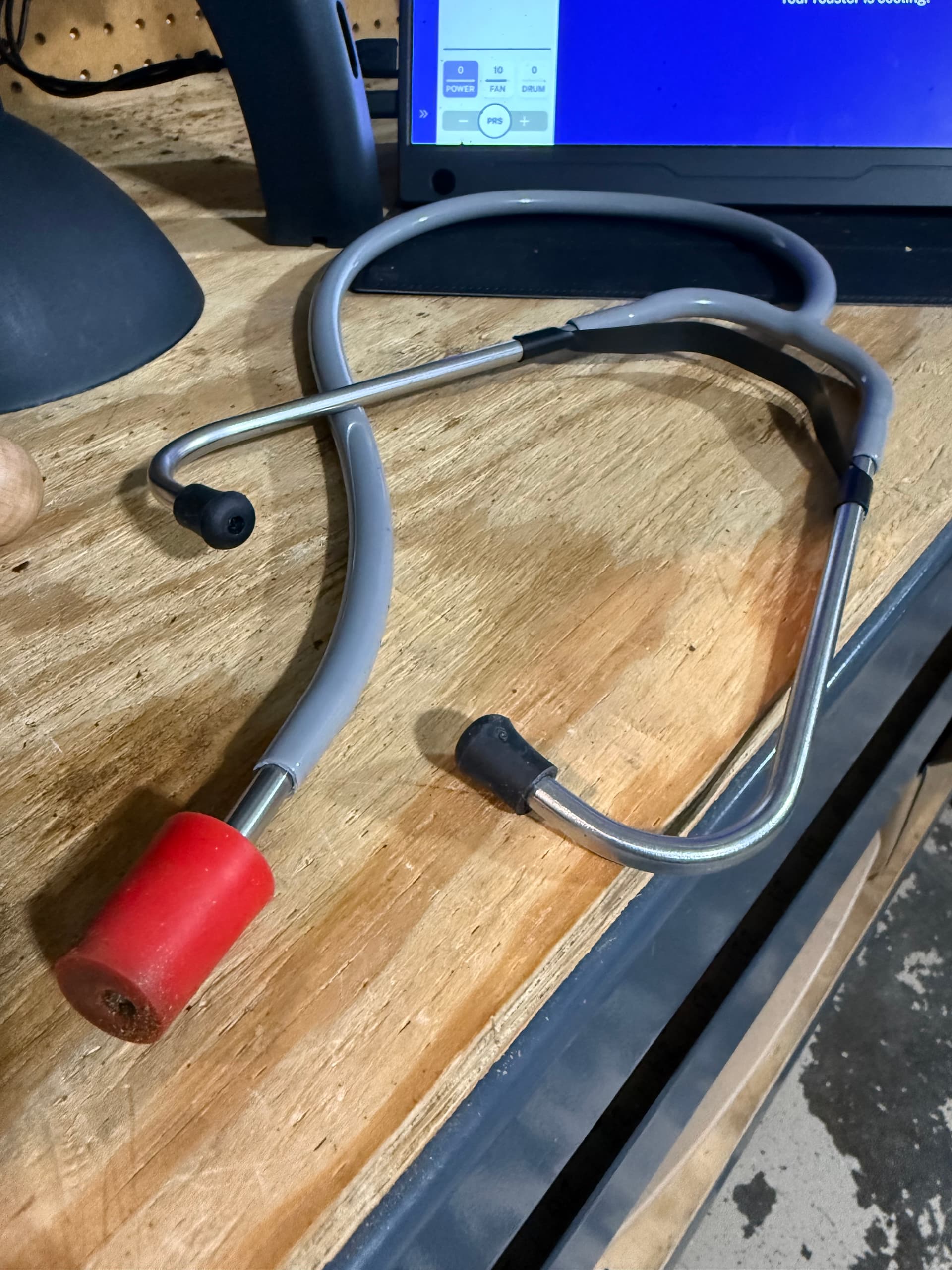
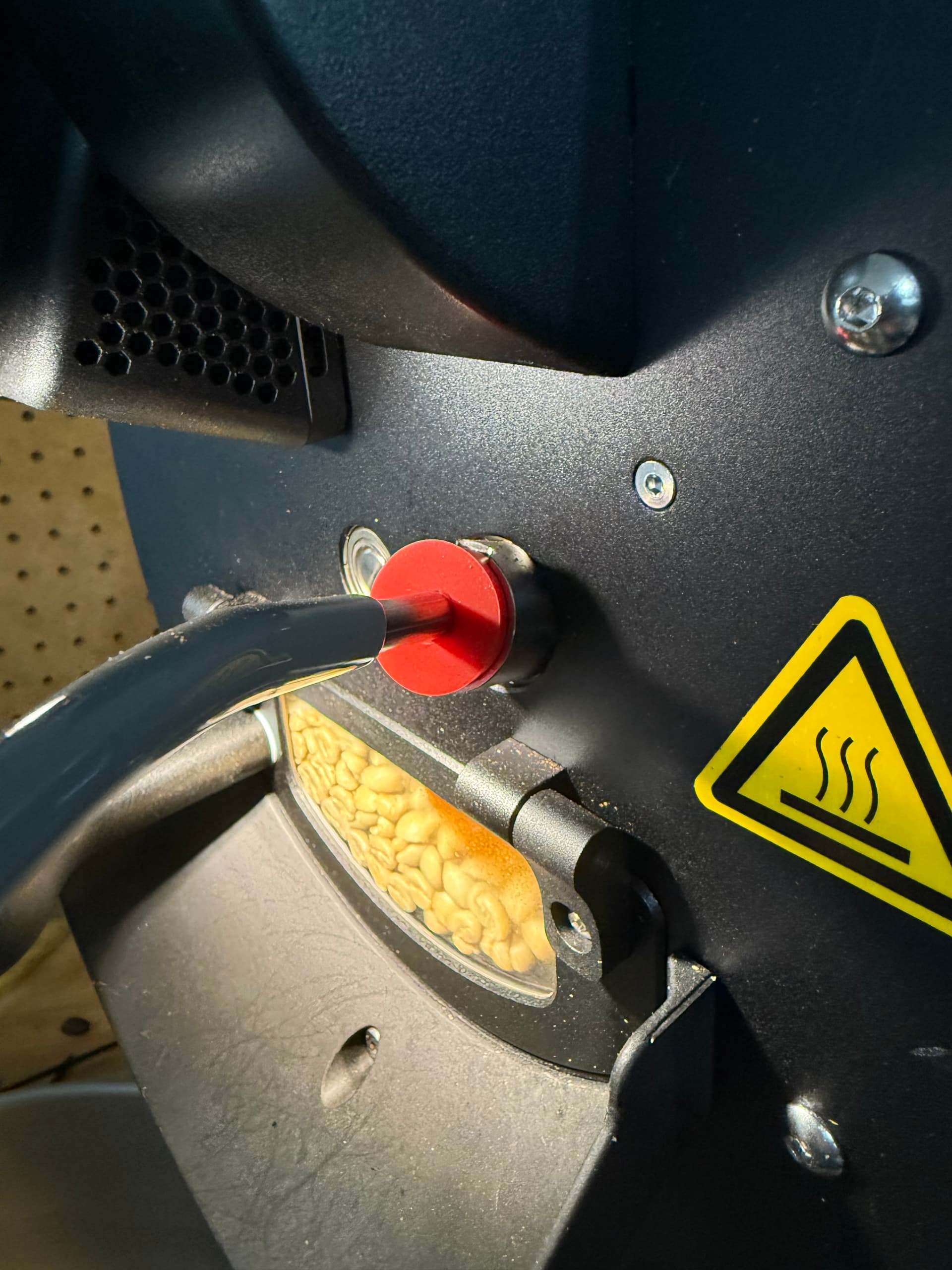
I’ve been using a mechanic’s stethoscope to monitor first and second crack on the Bullet R2 with very good results, so I wanted to share my setup in case it helps others.
I know this concept has been mentioned before, but here are the specifics of what I’m doing.
I started with a Lisle 52750 Dual Purpose Stethoscope Kit (about $27 on Amazon). I cut the stainless probe down to roughly 2 inches. That shortened probe is then inserted into a high-temp silicone tapered stopper (20mm). The stopper kit I used was a generic high-temp silicone plug set (around $10). I drilled a small hole through the stopper to create a tight, friction-fit seal around the probe.
This creates a clean acoustic path into the drum without picking up excess mechanical noise from the chassis. The result is excellent—I can clearly hear both first and second crack, even on beans that typically have a very faint or subtle crack.
As others have pointed out, determining exactly when to mark FC is somewhat subjective. But to your question, I really didn’t have much confidence in calling FC or SC before using the stethoscope. Between the drum and fan noise, it was just too difficult (for me) to hear them clearly.
With the stethoscope, that’s completely changed. I can now hear even the most subtle “thump,” not just at FC and SC, but even during the drying and Maillard phases. It’s made a noticeable difference in both confidence and consistency when marking events.
That confidence has also carried over into using AI to analyze my roasts and make recommendations for improvement. Having more reliable event markers going in has made that process far more useful—and it’s been a lot of fun.
Haha, controversy isn’t all bad. We don’t all have to agree, but healthy discussion is always beneficial as long as it stays respectful. And I definitely don’t have supersonic hearing (tongue in cheek), so the stethoscope has been a big help for me.
Great question on defining FC. Everyone seems to have their own approach, so here’s mine.
I tend to think of it like stovetop popcorn. I realize corn and coffee are very different and coffee goes through distinct roasting phases, but there are some useful parallels. In both cases, you have moisture turning to steam and causing a “pop,” and they don’t all happen at once. You get a few early outliers—those first sporadic pops.
I don’t consider those initial pops to be FC. For me, FC starts when the pops become more consistent and sustained, but not yet a full rolling crack. That transition point is what I mark.
Curious how others define it—always open to refining this.
I’ve found the active noise cancellation on my Apple AirPods Pro works pretty well for isolating cracks from the rest of the noise floor. Worth a try if you happen to have them or something similar.
This is an amazing idea! I was just speaking to my sister today about 5 roasts i did yesterday, and always have trouble pinpointing when FC starts. I’m going to try this on my next roast!
Squeakie, yes it’s a huge upgrade that takes a lot of the guesswork out of roasting (the timing of the FC and SC). Please post your feedback once you try it out.
Carldebar, Thank ou for this clear post, I am a hobby roaster in Amsterdam and orderded the sthetoscope and plugs on Amazon. My expierence is that with some beans and some roastprofiles, FC is really hard to hear, sometimes I hear nothing, and it must have heppend. Because I determine when to drop on delta time en delta temperature after FC calling FC is really important to me and I want to get more consistency in when to call FC. I do not think it matters when I call FC as long as do it consitently with all roasts. Thank you so much for suggesting an relatively easy solution. I can’t wait to try!
Thank you for reaching out and letting me know—I really appreciate it.
I think you’ll be amazed at how clearly you can hear what’s going on inside the drum with the stethoscope. It really takes the guesswork out of it.
Lately I’ve been roasting some Brazilian beans where FC is very subtle—more soft, sporadic pops rather than a robust, rolling crack. Even so, it’s still easy to identify when the crack begins. I’ve had excellent results with that added clarity.
Let me know how it works for you—I’d be interested to hear your experience.
This is great news. I came to the Bullet from a Hottop where the sounds of cracks were very easy to hear. The Bullet has a lot more bean splashing noise than the Hottop, probably because of the larger drum, so I just guess at FC based on IBTS readings. Not very accurate, but certainly repeatable. Hearing the cracks just might enable me to accurately calculate Maillard and development times instead of always wondering. Thank you for this information.
Taking the guesswork out of FC really is key if you want to be more precise with Maillard and development time. Once you can hear it clearly, everything downstream starts to make more sense and becomes more consistent.
One thing I’ve been experimenting with lately is using AI to analyze my roasts. I let AI do the deep research on each bean, then upload the finished roast graph and have it generate analysis and tasting notes. It’s been surprisingly accurate—especially how it ties the bean characteristics and the roast data together.
It’s also just been a lot of fun to play with. If you haven’t tried it yet, it’s worth exploring.
Are you using a particular AI program? Being able to directly send roast data and have it analyzed sounds like a great idea. I’m not aware of a program that allows you to do that.
Hey I like that high temp silicone stopper idea. I’ve been using a similar setup with a brass pipe fitting ever since I saw it on here way back when. Wondering if you still use the bean tryer with this setup? Can you put the stopper in and out easily?
Pretty much impossible for me to hear soft cracking beans without this.
@billyjackskin.Tdzn I don’t use the trier at all. At this point I rely entirely on my roast recipes, which have gone through multiple iterations and tweaks, with some AI assistance along the way, so the trier just isn’t necessary in my case.
Another reason I avoid using it is that every time the drum is opened to outside air, it affects the roast. The cooler ambient air rushing into the drum will pull temperature down, and you can see that immediately in the roast curve.
But yes, the stopper is fairly easy to remove. The only caution is that if you pull it during a roast, the surrounding metal will be very hot, so you need to be careful.
I don’t use it either. It’s really too small I think. Was just curious. I always see the Aillio guys using it though. I don’t run too many recipes because it seems like I always have a new bean going. A lot of peeps here will say you don’t need to hear FC as you can tell by the IBTS when it’s occurring which is true but I always like to listen and mark it when I have a good consistent cracking starting. I kind of doubt we’ll ever see the Aillio guys with a stethoscope but I can’t go without it now.
@billyjackskin.Tdzn Same here. I roast a lot of different beans too — right now I’ve got more than a dozen greens on hand from all over the world, and most of what I roast goes out the door to friends.
My experience has been that you really can’t depend on IBTS alone as a marker for first crack. Even with the same bean, it can shift depending on ambient temperature and humidity. I’m not looking to get into a debate about it, but that’s what I’ve seen from hard empirical data over a lot of roasts. For me, the stethoscope pretty much ends the debate. It lets you hear exactly what’s happening instead of inferring it indirectly.
What’s been interesting is that, with AI helping me remove so much of the guesswork, even on a new bean I’ve never roasted before, the first roast recipe now usually lands very close to where I want it.
If you haven’t seen it, check out my other post about using AI to help tweak recipes.