The answer is drink it don’t store it, I know, but my wife and I don’t drink that much and I like to roast at least five pounds at a time, so the question is storage. I have read several articles that say freezing coffee negatively effects the flavor, but I disagree. My father was a frozen food pioneer, so I have a little knowledge which makes me dangerous. So here’s my view, if after roasting and resting for a couple of days you **vacuum seal the beans in polyethene bags ** and freeze as long as you store in a dark freezer you will preserve the full flavor of the coffee. When its time to use I store in vacuum containers again not exposed to light. I believe within reason, frozen up to 6 months, you maintain the flavor of the roast. Typically my storage bags are less than a half pound, so they last about a week. I assert that even after 6 months the coffee retains very very close to its flavor after 3 days. What is the experience of the Roast Worlders?
May I recommend a possible improvement to your freezing workflow?
I am very happy to freeze coffee, but I don’t think polyethylene bags work all that well over the longer term. I can definitely perceive both a loss of positive qualities, and the ingress of negative aromas from the freezer environment… YMMV, but I’m talking about seal-a-meal type bags or Ziplocs.
I have had excellent results freezing coffee in glass canning jars, especially if it’s frozen within a day or two of roasting. I’d recommend freeing jars of a size you can use within a week or two-- remove from the freezer when ready to use, let them come up to room temp before opening to prevent condensation of moisture in the air on the cold beans. Then just reseal the jar and keep it out at room temp until it’s used up. I wouldn’t use a vacuum-- lower partial pressures can impact the aromatic profile of the coffee by encouraging more volatile aromas to exit the beans. I was in the wine business for a long time, and didn’t like the vacuum wine sealers for the same reason.
I’ve done this with coffee I use for espresso and drip, with no noticeable loss of quality.
Morgan:
Thanks for your feed back. To be more precise the material and in fact the system I use is made by a company named Food Saver. The material is not polyethylene but in fact a plastic designed for freezing food. Their claim is poly is good for 6 months, the material they use 2 years +. The sealing unit removes air and seals. I don’t think the material is odor permeable. I have compared 2 day roasted beans to 6 month old vacuum packed frozen beans and can not taste a difference. There is no doubt that glass is better than plastic and there are systems to remove the air which is the main culprit for flavor change over time. It sounds like you have a good system for your needs, appreciate your input.
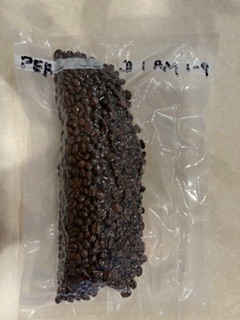
This is a image of a roughly half pound vacuum package of Peru Decaf Alto Mayo Roasted 1/9/2026.
Does implementing a silica sachet help in this workflow? Would it help absorb additional moisture or would it stripe the bean of it’s flavor?? That’s all I have to add, you eluded to this in your original post, but in my eyes less is more. I roast weekly/bi-weekly for my home consumption and rely on the Airscape containers to keep everything fresh.
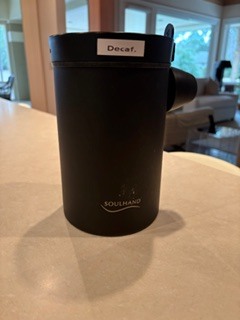
When its time to use the coffee I pour the frozen vacuum packed beans into a foil lined coffee bag and place it in a Soul Hand metal vacuum canister. You can google coffee canisters and there our a variety of them available. I like the solid metal, with the built in evacuator built into the lid. I have two one each for the current decaf and regular. This seems to work to keep the coffee flavor at it’s peak even if stored for months in total. The time in the canister is usually less than a week.
From what I’ve read and based on my own experience roasted coffee beans lose a significant percentage of their flavor in about a month when exposed to the atmosphere.
I think the “freezing coffee” is bad (or storing in your fridge for that matter) mostly came from when people use “leaky containers,” and then the coffee absorbs the flavors of all your leftovers that are also leaking in your fridge and freezer. That tends to not make things taste so good.
I’ve tried vacuum sealing my roasted beans as well, but my experience has been that vacuum-sealing freshly roasted beans is a bit futile, since the off-gassing they produce after roasting tends to negate the vacuum. Though that being said, they are then bathed in CO2, instead of our mix of air. I now just use canning jars. At one point, I thought it would be fun to use Beer Crowlers, but the seamers are cost-prohibitive for just personal use. Thinking of stuff like this:
You could even purge the cans with nitrogen or CO2 as well before sealing them up. I
I have a food saver now, but I tend to only roast 500g batches, because I like variety, so long term storage isn’t on my mind so much.
I use fermentation lids that fit on large mouth Mason jars. A few pumps with the included vacuum pump and the jars will hold a vacuum for several weeks.
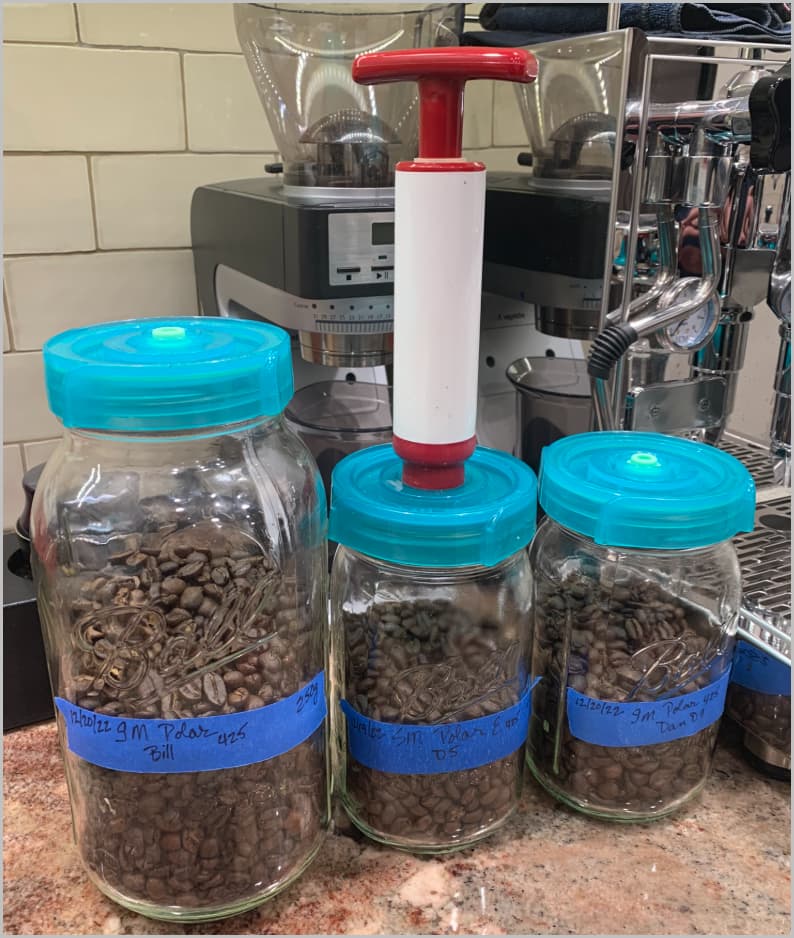
They are available from Amazon and are inexpensive.
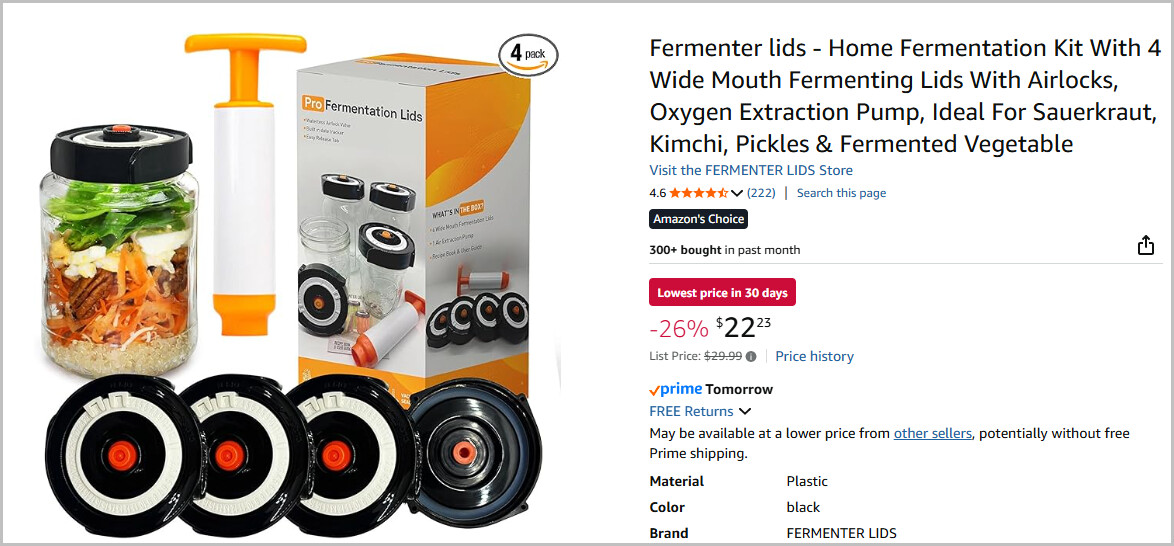
It is easy to pump it a few times after opening for brewing a cup and they will have a new vacuum. The little hand pump is nice because I don’t have to pull out the food saver.
I have recommended these to a few friends and one of them said that he had a hard time opening the lid when the jar was holding a vacuum. I pointed out that there is a small silicone valve that you can push with your finger and then hear the air rush in and then it is easy to open the jar.
I have been using these for a few years now and have no complaints.
Billc:
Looks like a good solution, particularly short term. For longer I assume you store in the dark. Clearly will extend flavor life vs exposure to air. Glass is the best.
brewweasel:
Your point is well taken, if you don’t allow the beans to off gas for two or three days you lose the vacuum although as you point out it is bathed in CO2. Three days and you maintain vacuum. You are also correct refrigeration is not good, if has to be frozen.
Yes, definitely stored in the dark.
I don’t freeze my roasted beans.
George Howell, who in my opinion is the godfather of specialty coffee and was very instrumental in developing cupping scoring, freezes his coffee. Both for the Green beans and after roasting for his coffee business in Boston:
From an article about him and freezing coffee:
George Howell is a pioneering figure in the specialty coffee industry who has long advocated for freezing coffee to preserve its quality and freshness.
He freezes green coffee beans immediately after harvest to halt the aging process, which otherwise causes coffee to lose its sweetness and vibrant flavors over time—comparing it to a color photograph fading to sepia. By storing green coffee at -40°C in specialized freezers , Howell ensures that the beans retain their complex aromatics and terroir-driven characteristics for extended periods. This allows his company, Terroir Coffee , to roast and sell high-quality coffees year-round, regardless of seasonal harvest cycles.
In addition to green coffee, Howell also freezes roasted coffee —a practice he calls a “complete myth” to avoid. He argues that freezing roasted beans, especially when sealed properly, preserves flavor better than any other storage method. His Boston café serves coffee that is frozen and only defrosted just before brewing, ensuring maximum freshness.
I have read that at home, he vacuum seals and freezes small bags of roasted coffee for his own personal comsumption.
My wife bought me 4 ounces of his Yemen, Al-Manshiya
It cost $104.00 for 4 ounces (that is over $400.00/pound)
It is the best coffee that I have ever tasted.
Another thing that might be detrimental for freezing coffee is that many freezers have an ongoing defrosting cycle that warms up the freezer section to melt the frost that accumulates. This might have an effect upon the beans if they are packaged in smaller bags.
Billc:
Very interesting. Of course because it coincides with my beliefs I’m a easy buy in. The thought of freezing green coffee didn’t cross my mind because of the accepted theory that green coffee doesn’t deteriorate, but of course it ages, just much slower. The other reason is the practical one, I’m lucky to get one shelf in our freezer (my great wife’s domain), but green coffee would get expensive. The other factor is the degree of improvement. We get good enough results with the steps we take. The expense and work would go up a lot, I’m guessing the flavor improvement not as much.
I have followed that same protocol for several years. I will put about 600g of coffee in a heat sealed valved bag and leave at room temp four days and then put in freezer. I’ll bring out a bag and put in container after reaching room temp typically five days or so before use. My wife and I will go through about 90g of coffee a day. I’ve been leaving coffee in the valved bags at room temp for four to six weeks and with some coffees (99.9% of the time it’s Columbian) and it’s aged well, sometimes maybe developed flavor more.
There’s no question that freezing roasted coffee preserves flavor. Royal Coffee published another article on testing they recently did in Roast magazine last month. Here’s a preview. I think the whole article is on Reddit somewhere also.
For myself I pack it in one way valve coffee bags and use my Mueller vacuum sealer to suck the air out and seal them and then I put those in freezer ziploc bags. The coffee bags expand some due to degassing and I wonder if vacuum sealing really does that much after seeing the way Royal did their experiment. But it can’t hurt.
I’ve been using this method since you first mentioned it with my assortment of 8 or 9 beans I have at any one time as my daily drinkers. I will pour out a small jar’s worth at a time in between vacuuming down. Works great and really keeps them fresh!
I too roast 10 lbs per session. I put the roasted coffee in zipper pouch coffee bags with the degas valve. I don’t wait, after the roasting session I immediately vacuum seal the bags and put them in the freezer. When the need arises I’ll get out a bag, remove it from the vacuum seal bag and let it degas for a couple days. I normally have ± 15 full pound bags of 2 or 3 different beans in the freezer. I give friends and family coffee regularly. I date the bags and have used coffee that’s 8-10 months from roast date with no discernible impact on flavor. I’ve been doing this for 4 years. I went thru 3 vacuum sealers that showed why the were inexpensive. I finally spent the money on a good Lem unit that has performed well for 2 1/2 years and counting. Just the way I do it and it works!