I am quite new to roasting and wanted to understand how do you stretch or reduce the Drying, Maillard and development phases respectively while keeping the over all time the same?
1 Like
Good question. Those three phases are the result of when yellowing (end of drying) and first crack (end of Maillard) land. You move them by shaping your heat/RoR curve, and since total time is fixed, stretching one borrows from another:
- More drying, less Maillard: charge cooler or ease off power early… yellowing lands later.
- Less drying, more Maillard: a bit more heat up front… yellowing sooner, more room before FC.
- More development: ease power down approaching FC so RoR keeps declining but stays positive past first crack. Don’t cut so hard it crashes… a stalled finish tastes baked, not developed.
Consistent tracking of the events makes it much easier to grasp over time.
4 Likes
A tool that I have always found useful, is a flexible curve ruler (from technical drawing - Linex - Fcg30 Flexible Curve). I have an electronic version (which I later found out exists in Artisan as well  ) here… Profilsimulering • Kvärn.
However, the ruler is much better. It’s quick and just works. The “profilesimulater” invites to too much nudging (and I forgot to add a shadow curve to compare against (will do that one day)). Of course, you can use anything that bends and has that bit of resistance that will give you a smooth spline.
What I will do is plot in milestones that I have and then using the flex ruler draw a curve between them. Then draw the milestones that I want and draw a curve between those. This will hint as to where you need to add energy and when to take it away again.
Yellowing and first crack will happen at roughly the same temperature, so those two milestones can only move in time. So to make first crack happen later while fixing yellowing, you need to remove energy.
p.s. A very good micro adjustment on the Bullet is the fan speed. The air flow temperature on the Bullet is cooler than the drum, so increasing fan speed will cool the beans everso slightly and vise versa.
3 Likes
Makes sense but somehow I have tried so many times but, never have been able to stretch my Maillard till date…… I guess I need to practise a lot more. Thanks this does give me a better systematic approach
I’m a new roaster as well and this is something that I’ve been interested in exploring. Not only stretching each phase but also tracking what it translates to in the cup. I’m a believer in the trial by error. Change one variable at a time and cup frecuently to observe changes.
If it helps, lately I’ve experimented with starting the roast with very high heat, low drum speed and as the ROR starts to climb I taper down the heat and speed up the drum.
My goal is to reach first crack with a minute left of the roast and to finish first crack as I finish the roast. I usually hit Yellowing at 4-5min and finish first crack at 9 min +.
I’m also commmenting to see if anyone has any preferences or tips to bring out sweeter and more elusive floral notes, I have some specialty coffees that I’ve been hesitant to roast because of lack of knowledge.
1 Like
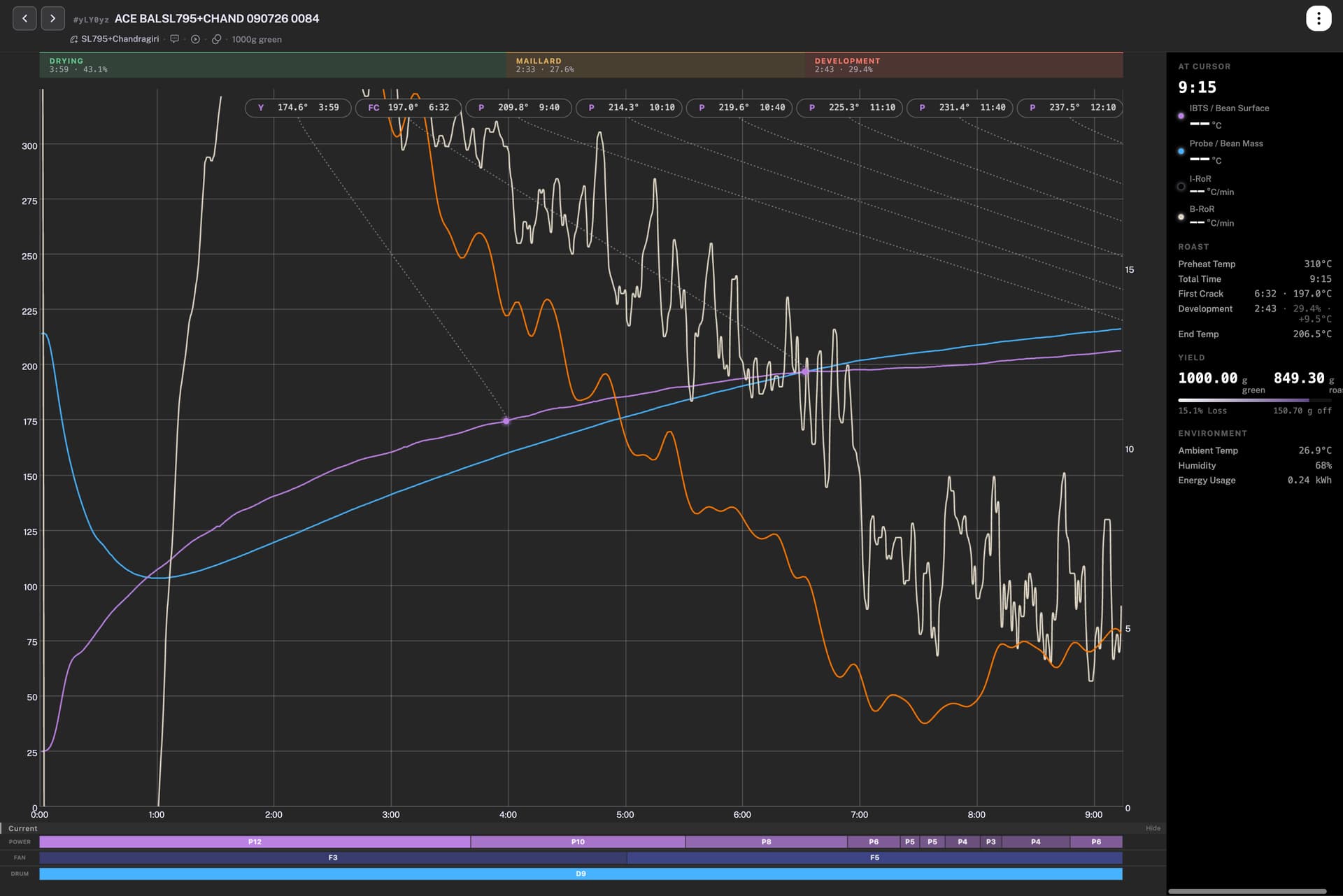
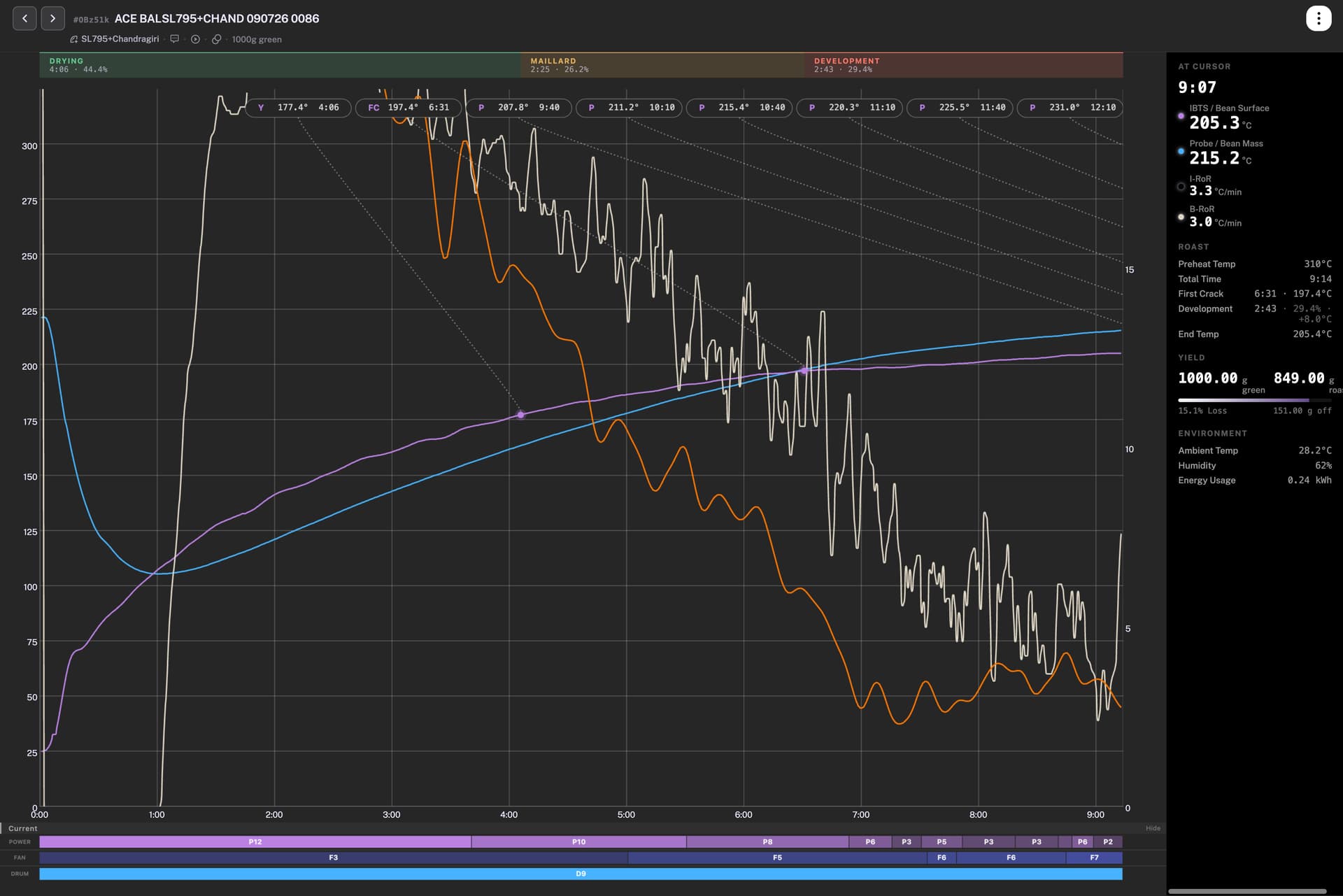
I have this perpetual problem of a ROR dip just after FC and then it starts rising as I reach the drop temperature. I have not been able to solve this yet 
If you manage to hit FC with a lower heat momentum than you are currently, you should be able to prevent the crash after FC. In effect you will be lengthening the Maillard with one or two P/F drops prior to FC. Hope this helps.
1 Like
here is my roast curve and as you see the problem i was describing. would you be kind enough to tell me what i could do differently in this roast to make it better. full honesty i haven’t tasted this coffee yet (still degassing) - any and many suggestions and critique will be truly appreciated
1 Like
if i shared a roast graph would you please tell me what i could do better to make the roast better - stretched Maillard. smoother ROR 
1 Like
@shoestring Can you send me the actual profile export from roastime? I have a software tool that may be able to help. I will run your data through and give you a link to the report. I need the exported csv file to do that.
That would be awesome. Thanks . Oops roast world doesn’t let me attach a .csv file
Also, I am writing an app that analyses and suggests roasts recipes and suggests corrections to ones roasts. I would love to know what is the software you use.
Once my app is presentable i would love to run it by you and others here to get suggestions and real world data to make it better.
Anyway for now how do i get the csv to you?
Thanks
Thanks
I emailed the roast profile.
Excited to read the analysis
Here is the analysis (will also email them to you in pdf)
Here is a plan to try
2 Likes
That could be from the moisture released from the beans during first crack. Possibly bumping the fan/power slightly during first crack could smooth that out, but to be honest, that is just my theory. I have yet to be able to put it in practice
1 Like
Yes that is the most logical explanation and I am going to try that today. Thanks